Slashdot Mirror
Domain: technovelgy.com
Stories and comments across the archive that link to technovelgy.com.
Comments · 237
-
Re:Good - Forget Mars
What makes Space Nutters think that these things are possible? Too much scifi and not enough actual knowledge.
Yeah, nothing that was imagined in science fiction ever became reality! Here's a nickel, kid, buy a better argument. Try getting a valid one, you'll be less boring.
-
Re:does it come with magnifying glasses?
Magnifiers... I sure wish Slashdot would allow better font size control on mobile phones, because it is just a tiny bit too small for me to read comfortably... so I zoom and then scroll left and right constantly which gets old and so I dont read much on my phone from here.
Oh, and I should have put the Dune link about the built-in magnifier on this thread.
http://technovelgy.com/ct/cont...
"The Orange Catholic bible is a syncretic work created far into our future, but also well into the past in Dune. This piece of technovelgy combines a set of inventions in one package. The pages are of a filament paper, to delicate to be touched - so the pages are moved by the book itself, using small static charges. I own a very small (2.5"x3.5") copy of the complete New Testament that has very thin pages - it's approximately 1/3" thick. The filament paper book also has an automatic paging system; it flips through itself. And, of course, a built-in magnifying glass."
-
1965 Dune, once again predicts the future
http://technovelgy.com/ct/cont...
"Before I go, I've a gift for you, something I came across in packing." He put an object on the table between them -- black, oblong, no larger than the end of Paul's thumb.
Paul looked at it. Yueh noted how the boy did not reach for it, and thought: How cautious he is.
"It's a very old Orange Catholic Bible made for space travelers. Not a filmbook, but actually printed on filament paper. It has its own magnifier and electrostatic charge system."
He picked it up, demonstrated. "The book is held closed by the charge, which forces against spring-locked covers. You press the edge -- thus, and the pages you've selected repel each other and the book opens."
"It's so small."
"But it has eighteen hundred pages. You press the edge -- thus, and so . . . and the charge moves ahead one page at a time as you read. Never touch the actual pages with your fingers. The filament tissue is too delicate." He closed the book, handed it to Paul. "Try it."
From Dune, by Frank Herbert.
Published by Putnam in 1965
Additional resources - -
Re:*Now* the business model is
Except that the person inside would be an illegal alien to keep labor costs low.
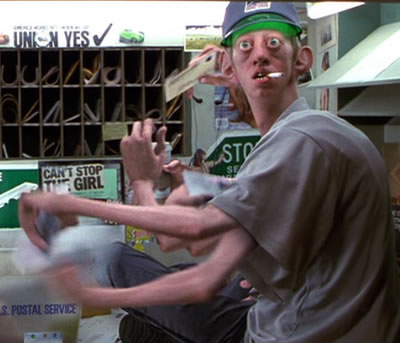
http://www.technovelgy.com/graphics/content07/postal-robot-mibII.jpg
-
SmartPhone is just a decoy name
Their real name is portable TELESCREENS; the way Oceania monitors and controls the population using a software tool called FACEBOOK. And this sort of thing was predicted decades in advance.
-
I have been waiting a long time for this...
Even though it didn't come out quite the way the book had it, at long last we will have - the deliverator .
-
Re:Texture of the meat
Just need to exercise it while it's growing.
Of course, then you have to worry about it escaping the factory.. ewwww, Bill Cosby. -
Copseye
As predicted by Larry Niven in 1972 short story, Cloak of Anarchy.
http://www.technovelgy.com/ct/...
Someone at police headquarters had expected that. Twice the usual number of copseyes floated overhead, waiting. Gold dots against blue, basketball-sized, twelve feet up. Each a television eye and a sonic stunner, each a hookup to police headquarters, they were there to enforce the law of the Park...
Within King's Free Park was an orderly approximation of anarchy. People were searched at the entrances. There were no weapons inside. The copseyes, floating overhead and out of reach were the next best thing to no law at all. -
Re:And they discovered that Slashdot has gone to H
That sounds like Vernor Vinge's Rainbows Edge, where the UCSD library instituted a controversial project to digitise their collection using exactly that method:
http://www.technovelgy.com/ct/...
(FAOD I'm not suggesting multiple authors haven't used the same idea.)
-
TANSTAAFL
-
Loogie gun
Not much chance of seeing this anytime soon, but it would be interesting...
-
Maybe not that far away
Smallest rfid chip is
-
Re:And thereby create a black market in organs...
Organlegging: Technology needed to deal in illicitly obtained body parts.
Bill Christensen wrote: As far as I know, Niven was the first writer to really work with a topic that is just starting to become a problem, thanks to drugs that make transplantation viable.
Indeed. I think the main thing he got wrong was the time window before artificial replacements become viable. He was thinking hundreds of years, but it's probably more like 25-50, with no rejection issues thanks to adult stem cell technology.
-
And thereby create a black market in organs...
Organlegging: Technology needed to deal in illicitly obtained body parts.
Bill Christensen wrote: As far as I know, Niven was the first writer to really work with a topic that is just starting to become a problem, thanks to drugs that make transplantation viable.
-
Re:If Apple or Google came up with this...
Google already did but it was an April Fool's joke in 2011.
And Douglas Adams did it before Google even existed:
A loud clatter of gunk music flooded through the Heart of Gold cabin as Zaphod searched the sub-etha radio wave bands for news of himself. The machine was rather difficult to operate. For years radios had been operated by means of pressing buttons and turning dials; then as the technology became more sophisticated the controls were made touch-sensitive--you merely had to brush the panels with your fingers; now all you had to do was wave your hand in the general direction of the components and hope. It saved a lot of muscular expenditure, of course, but meant that you had to sit infuriatingly still if you wanted to keep listening to the same program.
Zaphod waved a hand and the channel switched again.(grabbed from http://www.technovelgy.com/ct/content.asp?Bnum=1329)
-
Re:Did you expect something different?
It would be pretty darned hypocritical of us to indiscriminately bomb people and then say that you shouldn't use A.I.
Now that it's becoming well-known that drone operators get severe PTSD (an injury to the moral reasoning part of the brain), the USG is going to need some H-K drones to carry on their murderous adventures.
A.I.'s don't balk at attacking civilians either - they'll never be told that their maintenance budgets are funded by their targets' paycheck withholdings.
-
Re:DisintegrationLarry Niven's Slaver Disintegrator worked along similar lines, except it surpressed intermolecular bonds rather than nuclear ones. Pretty effective, and less danger of an entirely hypothetical side effect I first read about in the little-known but apparently seminal Terran Trade Authority book Spacecraft 2000-2100 AD regarding the Proximan Tarantula weapon:
Virtually undetectable in their screened silos, these sinister scarlet painted craft would wait until overrun by our advancing ground forces before blowing off their camouflages covers and erupting from beneath the surface with the shriek of jetstream They were heavily armoured and carried the most frightening and indiscriminate weapon of the War. Housed in each of the legs were multiple sub- atomic particle oscillators (SAPO) able to project an omni-directional field which disrupted the relationships between atomic components.
All matter within an effective range of 5-600 metres was instantly and entirely dispersed, leaving a circle of boiling gases, and occasionally particle collision would set off a chain of nuclear reactions which not only devastated a wider area but destroyed the Tarantula as well.
-
Re:Why is there an assumption of privacy?
digital billboards that use prisms to target personal adds to each car. You were web searching for a new pair of shoes last night, so on your commute to work, you keep seeing Nike, Zappos, and ADIDAS everywhere. It'll happen. Just give it time.
They already have digital billboards that can detect what radio station you're listening to and target ads based on the demographics of that station:
http://www.technovelgy.com/ct/science-fiction-news.asp?newsnum=981
It's probably only a matter of time (or perhaps it's already here) before they snoop cell phone signals to figure out who you are so they can target the ad.
-
For now, we recruit natural high-focus individuals
Later, we'll create them. Vernor Vinge called it.
-
Re:Danny Dunn Invisible Boy
Makes me shudder to think how many other sci-fi stories from childhood will come to real life.
See also, http://www.technovelgy.com/
-
Re:Sex
Simstim had to start somewhere.
-
Chicken Little, your time has come (almost)
No, not the disney Movie but the SF novel from 1952.
The Space Merchants, by Frederik Pohl (w/CM Kornbluth).
-
Gibson
Probably more importantly, so did Gibson.
-
Passive RFID tags
Passive RFID tags can have a lifespan of 20+ years. Source: http://www.technovelgy.com/ct/technology-article.asp?artnum=47
They're also dirt cheap. -
Prior Art
-
Re:I was talking to a friend of mine about the tra
Makes me worry about the future more than I already do.
""Cheer up, Flicka. Always remember that, when things seem darkest, they usually get considerably worse."
Heinlein "Podkayne of Mars", 1953. In a quote that is one of the earliest written references to a cell phone. How's that for going off topic?
-
Re:Heat and movement
That's how we got self-opening doors. When TOS came out and Disney was planning EPCOT, they saw Star Trek and their "imagineers" went to Paramount to find out how they accomplished it.
In "When The Sleeper Wakes" (1889) H. G. Wells describes an automatic upward sliding door. I would be amazed if there weren't working industrial examples even then.
The first automatic sliding doors for use by people were invented in 1954 by Lew Hewitt and Dee Horton; the first one was installed in 1960. It made use of a mat actuator. The idea came to them in the mid-1950's, when they saw that existing swing doors had difficulty operating in the high winds of Corpus Christi, Texas.
Upward sliding garage doors date from the 1920's; the first electric door openers (not automatic) were sold in 1926. The rolltop desk, which has a similar form, was around in the mid-eighteenth century.
What Disney admired was the speed and mechanical simplicity of the Star Trek prop.
-
Re:Their space program is underfunded...
I don't know.. there's probably loads of research to be done before the actual launch of the actual base.
Russia did recently organize (together with ESA) the Mars 500 experiment. It's not as "sexy" as actually sending a mission to Mars, but I am always impressed when all the more boring preparatory work just gets quietly and calmly worked on.
There's no hurry. If there is no large budget, focus first on life-support systems, on the right worms for regolith agriculture, lubrication of machinery in vacuum and moondust conditions, on how large the solar panels need to be for the miniature solar-panel-baking-oven, how well Calcium works as electricity wire, etc. etc.
They can always team up with their neighbours the Poles (Krakow moon radio station) or their other neighbours the Chinese (Chang'e program). -
Re:It's Basic Infrastructure
If you're a guest in my home, you're welcome to use the bandwidth, along with the lights and water. Can you imagine visitig a friend only to be told, "Look, here's the PIN code to unlock the lights, and here's the key in case you want to wash your hands."
I can imagine it, yes, but only because I use a lot of drugs, and I've read Philip K. Dick, someone who also did a lot of drugs in his time.
-
Re:Transcript - you ask, we deliver
Do you happen to work for Uncle Enzo? Because you are truly the Deliverator!
Thanks
-
Chicken Little
-
Re:Unlikeable
You must be pretty disappointed bymost fiction then.
No.
Great (or even good) novels don't depend on you liking the characters, they just have to be believable, or at least interesting.
There is a category of stories where this statement is true. Police procedurals, old-school "idea" science fiction... any story where what is going on is the important thing, or where the setting is the important thing. Consider the classic story "The Wabbler". There aren't even any characters in that story; there is a robot, too simple to even have any personality. The story works only because what is going on is interesting.
Heinlein commented that there are only a tiny handful of story types: "Boy Meets Girl", "The Man Who Learned Better", and "The Little Tailor". In keeping with the whimsical nature of these titles, I call stories where the plot or location is the most important part "Travelogue" stories.
But stories like that can also have strong characters. Some police procedurals have generic police detectives, but the most popular ones have quirky, interesting ones.
Most of the characters in Brave New World or 1984 aren't people you'd want as friends.
Brave New World definitely qualifies as a Travelogue story IMHO. I've only read it once, a long time ago, but I don't remember connecting with any of the characters; I only was interested in the imagined brave new world. So I'll agree with you on this one.
1984 works as a Travelogue, but Winston Smith is definitely a strong character with whom I made a connection. I don't feel I'm very much like him, but I was rooting for him, which made the ending that much more powerful. So I'll disagree with you on this one.
Now you consider Star Wars: A New Hope. Full of "sense of wonder", it could qualify as a Travelogue story. But we connect with Luke. We connect with Leia. The droids, Han and Chewie, Ben Kenobi... all strong characters with whom we can easily get some sort of emotional investment. Vader s a strong anti-hero, interesting to watch, and it's satisfying to see him spinning away at the end. Had the characters been flat (like in The Phantom Menace) the movie might still have won fans on its strength as a view into a nifty fantasy milieu, but it wouldn't be in the top 20 most popular movies at IMDB as it is (#17 when I just checked).
In any event, I guess I should make my statement stronger: It's hard to read a novel when the experience of reading it is unpleasant. I not only did not connect with the characters in Windup Girl, I'm tired of reading about them. That's bad.
steveha
-
yeah, but...
do you want to go with the "America's Most Wanted" set or the "Seperated at Birth" ?
fun, but in different ways, see... -
Chicken LittleI for one welcome our Vat-Grown Overlords
Chicken Little, a huge mass of cultured chicken breast, was kept alive by algae skimmed by nearly-slave labor from multistory towers of ponds surrounded by mirrors to focus the sunlight onto the ponds.
Scum-skimming wasn't hard to learn. You got up at dawn. You gulped a breakfast sliced not long ago from Chicken Little and washed it down with Coffiest. You put on your coveralls and took the cargo net up to your tier. In blazing noon from sunrise to sunset you walked your acres of shallow tanks crusted with algae. If you walked slowly, every thirty seconds or so you spotted a patch at maturity, bursting with yummy carbohydrates. You skimmed the patch with your skimmer and slung it down the well, where it would be baled, or processed into glucose to feed Chicken Little, who would be sliced and packed to feed people from Baffinland to Little America.
From The Space Merchants, by Frederik Pohl (w/CM Kornbluth).
Published by St. Martin's Press in 1952Read the link for the references to the REAL "Chicken Little" experiment that started it all.
-
Re:GimmickSnow Crash:
Smartwheels use sonar, laser range finding and millimeter wave radar to identify mufflers and other debris. Each one consists of a hub with many tiny spokes. Each spoke telescopes into five sections. On the end is a squat foot, rubber tread on the bottom, swiveling on a ball joint. As the wheel rolls, the feet plant themselves one at a time, almost glomming into one continuous tire. If you surf over a bump, the spokes contract to roll over it. If you surf over a pothole, the rubber prongs probe its asphalt depths. Either way, the shock is thereby absorbed, no thuds, smacks, vibrations, or clunks will make their way into the plank or the Converse hightops with which you tread it.
-
I'm not Larry Niven
but I approve of this message.
Photovoltaic paint FTW! If only it weren't operating on the same deployment timeline as flying cars and strong AI.
-
bats cave
I want one that is still closed:
-
Re:Caution is in order in my opinion
http://www.drfuhrman.com/library/article16.aspx
http://www.healthpromoting.com/article/breaking-free-dietary-pleasure-trapAnd also: "Supernormal Stimuli: How Primal Urges Overran Their Evolutionary Purpose"
http://books.google.com/books?id=HQlg3rQquUoCAll to support your concern...
Another aspect, that animals may turn to addictive-seeming behavior under stress:
http://en.wikipedia.org/wiki/Rat_ParkSee also Larry Niven's fictional "Droud":
http://www.technovelgy.com/ct/content.asp?Bnum=207 -
"Chicken Little" has been around for a long time
See for yourself
Chicken Little
http://www.technovelgy.com/ct/content.asp?Bnum=1002 -
Too slow.
From observation to collection, the harvesting process takes about 9 seconds per berry. That's too slow.
This isn't the first strawberry-picking robot. Here's one from five years ago. But compare this with a commercial strawberry harvester that's just digging up the beds. (Note, incidentally, that the tractor is driverless. That's standard precision farming technology today; several GPS manufacturers make the gear for that.)
Automated fruit sorting using computer vision is a routine process, and it's really fast. Small-fruit sorting machines are strange to watch. Cameras watch the fruit go by, and air jets push it around. This is all happening in bulk, much faster than humans can even watch, as big conveyors pump a stream of mixed product through the machine and streams of sorted product come out.
Robotic tomato pickers have been built by several groups, but so far the machines are too slow and the cost is too high.
In practice, the way agricultural sorting works is that the good stuff is sold is fresh fruit, the not-so-good stuff goes off to make jellies, tomato paste, and such, and the rejected stuff becomes animal feed or fertilizer.
-
Palm Vein Scanners anyone?
Wonder why people are not focusing more on things like palm vein scanners? http://www.technovelgy.com/ct/Science-Fiction-News.asp?NewsNum=1147
-
how soon to working Tleilaxu Eyes?
-
Larry Niven saw this coming
Synthetic organs from A Gift from Earth.
"liverbeasts", "heartbeasts"... heh. Cute. Now if we could just get safe Bussard ramjets (or maybe hyperdrive).
-
Re:The future of robotics
Well, yeah...
-
useful? sensors!
if something useful existed that could make use of these batteries?
Like vernor vinge's localizers perhaps?
-
useful? sensors!
if something useful existed that could make use of these batteries?
Like vernor vinge's localizers perhaps?
-
Re:You ain't seen nothing yet..
Look at the numbers again and you will see that those numbers are less that population growth. Population growth alone in the 2000s was about 26 million people. One can expect the same again for the 2010s. We're talking two decades worth of jobs that have to be created by 2020, so, about 30 million new jobs for 50 million new people.
It's true that people are still employed in construction, even with the recent bust:
"Construction Employment Trends Short and Long Term"
http://www.tauc.org/toolsResources/industry/index.cfm?fa=article&id=1411
But for how much longer will we need all these people in the construction trades given new designs that are easier to assemble or involve automation? For example, people are working on huge robots that essentially print houses:
http://www.technovelgy.com/ct/Science-Fiction-News.asp?NewsNum=57
http://www.technovelgy.com/ct/Science-Fiction-News.asp?NewsNum=900You're reciting economic dogma but not looking at the points on limited demand and the successive replacement of agriculture, manufacturing, and now *services*.
Where are these 30 million net new jobs to come from, especially as robotics and other automation, better design, and voluntary social networks takes even more jobs? Not only do you need to replace all the newspaper jobs we're losing, but then you have to invent 30 million new jobs in addition to those. Sure, we may well see some few millions of green jobs for a time, but what else? And at what point do most people say enough is enough as far as too much stuff and too many supersized meals that are killing them?
Anyway, your (mainstream) prediction that the system will just correct itself when I can point to trends that are replacing vast numbers of humans just seems like wishful thinking to me.
In order for mainstream economists wishful thinking to be true (these are the same people who missed predicting the Great Recession, btw), three things need to hold true, all of which are false:
* wealth from improved productivity needs to be widely distributed so it can be spent and not just stashed away or put in a "casino economy" of complex financial gambling (like with derivatives), but thirty years of US statistics says it has been getting more concentrated;
http://www.capitalismhitsthefan.com/
* demand needs to rise as fast as productivity, but Maslow's hierarchy of needs suggests people at some point turn to non-materialistic pursuits that are generally easy to satisfy;
http://science.slashdot.org/story/10/09/07/1519221/Researchers-Say-Happiness-Costs-75k
* robots and computers need to never be able to be as smart and capable as most people, but we are already seeing that now in many limited domains (where the technology is smarter and more reliable than people at many complex tasks).
http://www.youtube.com/watch?v=W0Z8TR4ToNsThis is a phase change in our society. But, by so many people denying it and engaging in wishful thinking, reforms are being delayed, and suffering increased. Possible good solutions include a mix of a "basic income", democratic resource-based planning, a gift economy, and/or improved local subsistence in strong local communities.
What would it take to convince you (or most people) that wealth is concentrating, demand for stuff and paid services is limited, and/or robots and computers are getting better and better at replacing most human workers?
-
Re:You ain't seen nothing yet..
Look at the numbers again and you will see that those numbers are less that population growth. Population growth alone in the 2000s was about 26 million people. One can expect the same again for the 2010s. We're talking two decades worth of jobs that have to be created by 2020, so, about 30 million new jobs for 50 million new people.
It's true that people are still employed in construction, even with the recent bust:
"Construction Employment Trends Short and Long Term"
http://www.tauc.org/toolsResources/industry/index.cfm?fa=article&id=1411
But for how much longer will we need all these people in the construction trades given new designs that are easier to assemble or involve automation? For example, people are working on huge robots that essentially print houses:
http://www.technovelgy.com/ct/Science-Fiction-News.asp?NewsNum=57
http://www.technovelgy.com/ct/Science-Fiction-News.asp?NewsNum=900You're reciting economic dogma but not looking at the points on limited demand and the successive replacement of agriculture, manufacturing, and now *services*.
Where are these 30 million net new jobs to come from, especially as robotics and other automation, better design, and voluntary social networks takes even more jobs? Not only do you need to replace all the newspaper jobs we're losing, but then you have to invent 30 million new jobs in addition to those. Sure, we may well see some few millions of green jobs for a time, but what else? And at what point do most people say enough is enough as far as too much stuff and too many supersized meals that are killing them?
Anyway, your (mainstream) prediction that the system will just correct itself when I can point to trends that are replacing vast numbers of humans just seems like wishful thinking to me.
In order for mainstream economists wishful thinking to be true (these are the same people who missed predicting the Great Recession, btw), three things need to hold true, all of which are false:
* wealth from improved productivity needs to be widely distributed so it can be spent and not just stashed away or put in a "casino economy" of complex financial gambling (like with derivatives), but thirty years of US statistics says it has been getting more concentrated;
http://www.capitalismhitsthefan.com/
* demand needs to rise as fast as productivity, but Maslow's hierarchy of needs suggests people at some point turn to non-materialistic pursuits that are generally easy to satisfy;
http://science.slashdot.org/story/10/09/07/1519221/Researchers-Say-Happiness-Costs-75k
* robots and computers need to never be able to be as smart and capable as most people, but we are already seeing that now in many limited domains (where the technology is smarter and more reliable than people at many complex tasks).
http://www.youtube.com/watch?v=W0Z8TR4ToNsThis is a phase change in our society. But, by so many people denying it and engaging in wishful thinking, reforms are being delayed, and suffering increased. Possible good solutions include a mix of a "basic income", democratic resource-based planning, a gift economy, and/or improved local subsistence in strong local communities.
What would it take to convince you (or most people) that wealth is concentrating, demand for stuff and paid services is limited, and/or robots and computers are getting better and better at replacing most human workers?
-
Re:Reason #0
Real-life zombies are probably more subtle. They probably live among us, and you don't even realize it!
Read this about parasites that can alter human and other mammal behavior and come back and say it isn't as much of a stretch as you'd think:
http://www.technovelgy.com/ct/Science-Fiction-News.asp?NewsNum=547Case in point: cat ladies.
-
Re:BBC Planet Earth shows this
Yeah, forget the article, the BBC coverage is much much more awesome! Here's an excerpt of just the cordyceps portion:
http://www.youtube.com/watch?v=CCOQ0VU24xwThey mention that the other ants in the colony can usually detect when one of the ants gets infected, and actually move her as far from the colony as possible if they can before she goes all Zahn on them.
I remember stumbling upon it when I was watching videos about other parasites. Some good stuff out there... There are also parasites that can do mind control on mammals:
http://www.technovelgy.com/ct/Science-Fiction-News.asp?NewsNum=547While you're at it, minus while look for bot fly larvae and of course the intestinal parasites while you're at it. Pleasant dreams!