Slashdot Mirror
Domain: reuters.com
Stories and comments across the archive that link to reuters.com.
Stories · 2,473
-
Free To Play, Expensive To Love: 'Fortnite' Changes Video Game Business (reuters.com)
An anonymous reader shares a report: To see the storm that online video game "Fortnite" has unleashed on the world, just visit Jett Sacher in Brooklyn. The 13-year-old spends an hour or two every day on the game with his friends and is not afraid to spend his pocket money on it - bit by bit. "So I bought one dance, two skins and the battle pass," Sacher told Reuters TV about recent gaming sessions. "So that's, I spent $20 on both skins so $40 ... and the dance was another $10 so $50, 60 bucks, something like that."
Sacher's pay-as-you-go expenditure on dressing up his online avatar in the 'free-to-play' game helped "Fortnite" take in an estimated $223 million from in-game purchases in March, according to Joost Van Dreunen at research firm SuperData. "Fortnite," a sort of hybrid of "The Hunger Games" and "Minecraft," drops 100 people onto an island to fight each other for survival. It is a game-changer in the industry, analysts have said, because of the huge revenue it is making from "tween" and teenage boys purchasing outfits and other add-ons. Its publisher, Epic Games, is now worth $4.5 billion, according to an estimate. Further reading: Gamers are the new stars. Esports arenas are the new movie theaters (The New York Times). -
Twitter Says Glitch Exposed 'Substantial' Number of Users' Passwords In Plain Text (reuters.com)
Twitter is urging its more than 330 million users to change their passwords after a glitch exposed some in plain text on its internal computer network. Reuters is first to report the news: The social network said an internal investigation had found no indication passwords were stolen or misused by insiders, but that it urged all users to consider changing their passwords "out of an abundance of caution." The blog did not say how many passwords were affected. Here's what Twitter has to say about the bug: "We mask passwords through a process called hashing using a function known as bcrypt, which replaces the actual password with a random set of numbers and letters that are stored in Twitter's system. This allows our systems to validate your account credentials without revealing your password. This is an industry standard. Due to a bug, passwords were written to an internal log before completing the hashing process. We found this error ourselves, removed the passwords, and are implementing plans to prevent this bug from happening again."
The social networking service is asking users to change their password "on all services where you've used this password." You can do so via the password settings page. -
'Next Generation' Flaws Found on Computer Processors (reuters.com)
An anonymous reader shares a report: Researchers have found eight new flaws in computer central processing units that resemble the Meltdown and Spectre bugs revealed in January, a German computing magazine reported on Thursday. The magazine, called c't, said it was aware of Intel's plans to patch the flaws, adding that some chips designed by ARM Holdings, a unit of Japan's Softbank, might be affected, while work was continuing to establish whether Advanced Micro Devices chips were vulnerable. Meltdown and Spectre bugs could reveal the contents of a computer's central processing unit -- designed to be a secure inner sanctum -- either by bypassing hardware barriers or by tricking applications into giving up secret information. -
Iran Bans Use of Telegram Messaging App To Protect 'National Security' (reuters.com)
Iran has banned all use of the popular Telegram messaging app. The ban had been introduced to protect "national security," said a statement aired on state television. From a report: Iran had been considering the ban since January when protests over economic grievances erupted in more than 80 cities and later turned into demonstrations against the clerical and security elite of the Islamic Republic. Some hardline officials said protesters used Telegram to organize the rallies, which were ultimately contained by the Revolutionary Guards and their affiliated volunteer Basij militia. The app was temporarily blocked in January. "Considering various complaints against the Telegram social networking app by Iranian citizens, and based on the demand of security organizations to confront the illegal activities of Telegram, the judiciary has banned its usage in Iran," state TV reported. "All Internet providers in Iran must take steps to block Telegram's website and app as of April 30," the judiciary website Mizan quoted a court order as saying. -
The Auto Plants of the Future May Have a Surprisingly Human Touch (reuters.com)
Carmakers have big plans for their next generation of factories: smarter designs, artificial intelligence and collaborative robots building a wide range of vehicles on the same line. From a report: The plants will also feature a component they say is the secret ingredient to flexible manufacturing: humans. SAIC-GM's factory in Shanghai, which opened in 2016, is one of the world's most advanced auto plants, assembling Buick minivans and Cadillac sedans and SUVs, including the CT-6 plug-in hybrid for U.S. consumers. GM's Shanghai plant is expected to eventually produce new electric vehicles, primarily for the Chinese market, executives have said. The plant, which GM operates with Chinese partner SAIC Motor Corp Ltd, feels almost like a scene from a Star Wars film, with battalions of machines quietly working in self-directed harmony. Collaborative robots, or "cobots," painted matte green and unrestrained by the steel cages that surround their larger industrial cousins, are being programmed to work alongside humans on the line. One unusual operation advanced models now handle is installing gears in transmissions. -
US Keeps China, Puts Canada on IP Priority Watch List (reuters.com)
The Trump administration on Friday labeled 36 countries as inadequately protecting U.S. intellectual property rights, keeping China on a priority watch list and adding Canada over concerns about its border controls and pharmaceutical practices. From a report: The U.S. Trade Representative's annual report on global IP concerns is separate from the "Section 301" report on Chinese technology transfer practices that has led the world's two largest economies to threaten each other with tariffs. The so-called "Special 301 Report on Intellectual Property Rights" calls out China for its "coercive technology transfer practices" and "trade secret theft, rampant online piracy, and counterfeit manufacturing." It was the 14th straight year that China was placed on the "Priority Watch List." U.S. Trade Representative Robert Lighthizer is due to travel to China next week along with other senior Trump administration officials for talks on U.S. demands for changes in Beijing's trade and intellectual property policies. -
Sprint, T-Mobile Aiming To Reach Merger Deal Next Week (reuters.com)
An anonymous reader quotes a report from Reuters: U.S. wireless carriers T-Mobile and Sprint have made progress in negotiating merger terms and are aiming to successfully complete deal talks as early as next week. The combined company would have more than 127 million customers and could create more formidable competition for the No.1 and No.2 wireless players, Verizon and AT&T, amid a race to expand offerings in 5G, the next generation of wireless technology. T-Mobile majority-owner Deutsche Telekom and Japan's SoftBank, which controls Sprint, are considering an agreement that would dictate how they exercise voting control over the combined company. This could allow Deutsche Telekom to consolidate the combined company on its books, even without owning a majority stake. Deutsche Telekom owns more than 63 percent of T-Mobile, while SoftBank owns 84.7 percent of Sprint. Deutsche Telekom and T-Mobile are also in the process of finalizing the debt financing package they will use to fund the deal, the sources said. There is no certainty that a deal will be reached, the sources cautioned. -
Trump Meets With Apple's Tim Cook To Talk Trade (reuters.com)
New submitter genfail shares a report from Reuters: President Donald Trump met with Apple CEO Tim Cook on Wednesday to discuss trade issues as the technology industry grapples with a U.S. spat over import tariffs with China, a manufacturing hub for the iPhone maker and other companies. Apple, the world's largest technology company, and other hardware makers have deep ties with China, where many of their products are built for export around the world. Cook urged an easing of U.S.-China tensions and called for more open trade after the trade dispute flared last month between the world's two largest economies. Trump announced about $50 billion in planned tariffs on certain Chinese imports, China retaliated with proposed tariffs on some American goods and Trump responded that the United States could counter with $100 billion in additional levies. U.S. and Chinese officials have been working to resolve the dispute. -
EPA Proposes Limits To Science Used In Rulemaking (reuters.com)
An anonymous reader quotes a report from Reuters: The U.S. Environmental Protection Agency proposed a rule on Tuesday that would limit the kinds of scientific research it can use in crafting regulations, an apparent concession to big business that has long requested such restrictions. Under the new proposals, the EPA will no longer be able to rely on scientific research that is underpinned by confidential medical and industry data. The measure was billed by EPA Administrator Scott Pruitt as a way to boost transparency for the benefit of the industries his agency regulates. But scientists and former EPA officials worry it will hamstring the agency's ability to protect public health by putting key data off limits.
The EPA has for decades relied on scientific research that is rooted in confidential medical and industry data as a basis for its air, water and chemicals rules. While it publishes enormous amounts of research and data to the public, the confidential material is held back. Business interests have argued the practice is tantamount to writing laws behind closed doors and unfairly prevents them from vetting the research underpinning the EPA's often costly regulatory requirements. They argue that if the data cannot be published, the rules should not be adopted. But ex-EPA officials say the practice is vital. -
WhatsApp Raises Minimum Age In Europe To 16 Ahead of Data Law Change (reuters.com)
WhatsApp is raising its minimum age from 13 to 16 in Europe to help it comply with new data privacy rules coming into force next month. The app will ask European users to confirm they are at least 16 years old when they are prompted to agree to new terms of service and a privacy policy provided by a new WhatsApp Ireland entity in the next few weeks. Reuters reports: Facebook, which has a separate data policy, is taking a different approach to teens aged between 13 and 15 in order to comply with the European General Data Protection Regulation (GDPR) law. It is asking them to nominate a parent or guardian to give permission for them to share information on the platform, otherwise they will not see a fully personalized version of the social media platform. But WhatsApp, which had more than 1.5 billion users in January according to Facebook, said in a blog post it was not asking for any new rights to collect personal information in the agreement it has created for the European Union. WhatsApp's minimum age of use will remain 13 years in the rest of the world, in line with its parent. -
EU Opens Competition Probe Into Apple's Bid For Music App Shazam (reuters.com)
EU antitrust regulators opened an investigation on Monday into Apple's bid for British music discovery app Shazam, concerned the deal might give the iPhone maker an unfair advantage in poaching users from its rivals. From a report: Apple announced the deal in December to help it better compete with industry leader Spotify. Shazam lets users identify songs by pointing a smartphone at the audio source. The European Commission said it was concerned about Apple's access to data on Shazam's users who use competing music streaming services in Europe. -
Wells Fargo Agrees to $1 Billion Fine Over Home and Auto Loan Abuses (reuters.com)
Wells Fargo got hit with a $1 billion fine Friday -- the largest ever issued by America's consumer protection agency. An anonymous reader quotes Reuters: Taken together, the mortgage and auto programs ensnared more than 600,000 customers and will require nearly $300 million in refunds, the bank has said. The programs allowed Wells Fargo to earn fees from unneeded car insurance and penalties on mortgage paperwork that the bank had botched. For homebuyers, Wells Fargo promised to "rate lock" or freeze the interest rate for borrowers who got their mortgage paperwork finished within a few weeks. When that deadline slipped and it was the bank's fault, Wells Fargo could blame the customer. The penalty for late mortgage paperwork often topped $1000, according to a borrower lawsuit...
Drivers stung by insurance fees were wrongly pushed into policies that they did not need... Insurers working for Wells Fargo pushed policies onto more than 500,000 customers who already had coverage, the bank has said.
The penalty comes 18 months after Wells Fargo "admitted it opened sham accounts for customers -- a practice that likely ensnared millions...
Wells Fargo agreed to the new $1 billion fine "without admitting or denying wrongdoing." -
Qualcomm Cutting 1,500 Jobs At Its California Offices (reuters.com)
As part of its promise to investors to cut annual costs by $1 billion, Qualcomm is cutting 1,500 jobs across multiple divisions at its offices in California. Reuters reports: The company, which has about 33,800 employees as of Sept.24, informed about its job cut plans in California in a regulatory notice that was filed with the state on April 18. Qualcomm said it plans to cut 1,231 jobs in its San Diego office and 269 from its San Jose and Santa Clara offices in the state. Though the company first considered cost reductions without layoffs, it concluded that job cuts are needed to support long-term growth and success, a Qualcomm spokesperson said on Wednesday. -
ZTE Exports Ban May Mean No Google Apps, a Death Sentence For Its Smartphones (arstechnica.com)
New submitter krazy1 shares a report from Ars Technica: The U.S. government is going after another Chinese Android device maker. After shutting down Huawei's carrier deals and retail partners, the government is now pursuing ZTE. The U.S. Department of Commerce has banned U.S. companies from selling parts and software to ZTE for seven years. ZTE was caught violating U.S. sanctions by illegally shipping telecommunications equipment to Iran and North Korea. The company then made things worse by "making false statements and obstructing justice, including through preventing disclosure to and affirmatively misleading the U.S. Government," according to the Department of Commerce.
The latest news from Reuters raises even bigger issues for ZTE, though. A source told Reuters that "The Commerce Department decision means ZTE Corp may not be able to use Google's Android operating system in its mobile devices." Android is free and open source and will probably remain free for ZTE to use without Google's involvement. Reuters' source is probably referring to the Google apps, which aren't sold to device makers but are carefully licensed to them in exchange for other concessions. The Google apps package includes popular services like Gmail and Google Maps, and it also unlocks the Play Store, Google Play Services, and the entire Android app ecosystem. For a market-viable Android device, the Play Store is pretty much mandatory in every country other than China. So while ZTE could conceivably source hardware components from non-U.S. sources, being locked out of the Play Store would devastate ZTE's smartphones worldwide. -
Facebook To Put 1.5 Billion Users Out of Reach of New EU Privacy Law (reuters.com)
An anonymous reader quotes a report from Facebook: If a new European law restricting what companies can do with people's online data went into effect tomorrow, almost 1.9 billion Facebook users around the world would be protected by it. The online social network is making changes that ensure the number will be much smaller. Facebook members outside the United States and Canada, whether they know it or not, are currently governed by terms of service agreed with the company's international headquarters in Ireland. Next month, Facebook is planning to make that the case for only European users, meaning 1.5 billion members in Africa, Asia, Australia and Latin America will not fall under the European Union's General Data Protection Regulation (GDPR), which takes effect on May 25. That removes a huge potential liability for Facebook, as the new EU law allows for fines of up to 4 percent of global annual revenue for infractions, which in Facebook's case could mean billions of dollars. -
Iran Bans State Bodies From Using Telegram App, Khamenei Shuts Account (reuters.com)
Iran banned government bodies on Wednesday from using the popular Telegram instant messaging app as Supreme Leader Ayatollah Ali Khamenei's office said his account would shut down to protect national security, Iranian media reported. From a report: ISNA news agency did not give a reason for the government ban on the service which lets people send encrypted messages and has an estimated 40 million users in the Islamic Republic. The order came days after Russia -- Iran's ally in the Syrian war -- started blocking the app in its territory following the company's repeated refusal to give Russian state security services access to users' secret messages. Iran's government banned "all state bodies from using the foreign messaging app," according to ISNA. -
Cambridge Analytica Planned To Launch Its Own Cryptocurrency (theverge.com)
Cambridge Analytica, the data analytics firm that harvested millions of Facebook profiles of U.S. voters, attempted to develop its own cryptocurrency this past year and intended to raise funds through an initial coin offering. The digital coin would have helped people store online personal data and even sell it, former Cambridge Analytica employee Brittany Kaiser told The New York Times. The Verge reports: Cambridge Analytica, which obtained the data of 87 million Facebook users, was hoping to raise as much as $30 million through the venture, anonymous sources told Reuters. Cambridge Analytica confirmed to Reuters that it had previously explored blockchain technology, but did not confirm the coin offering and didn't say whether efforts are still underway. The company also reportedly attempted to promote another digital currency behind the scenes. It arranged for potential investors to take a vacation trip to Macau in support of Dragon Coin, a cryptocurrency aimed at casino players. Dragon Coin has been supported by a Macau gangster Wan Kuok-koi, nicknamed Broken Tooth, according to documents obtained by the Times. Cambridge Analytica started working on its own initial coin offering mid-2017 and the initiative was overseen in part by CEO Alexander Nix and former employee Brittany Kaiser. The company's plans to launch an ICO were still in the early stages when Nix was suspended last month and the Facebook data leak started to gain public attention. -
T-Mobile To Pay $40 Million Over False Ring Tones on Rural US Calls (reuters.com)
David Shepardson, writing for Reuters: T-Mobile USA agreed on Monday to pay $40 million to resolve a government investigation that found it failed to correct problems with delivering calls in rural areas and inserted false ring tones in hundreds of millions of calls, the Federal Communications Commission said. T-Mobile, a unit of Deutsche Telekom, agreed to changes and acknowledged that it had injected false ring tones into hundreds of millions of long-distance rural calls, the FCC said, in violation of FCC rules.
False ring tones "cause callers to believe that the phone is ringing at the called party's premises when it is not," the FCC said, noting uncompleted calls "cause rural businesses to lose revenue, impede medical professionals from reaching patients in rural areas, cut families off from their relatives, and create the potential for dangerous delays in public safety communications." -
France is Building Its Own Encrypted Messaging Service To Ease Fears That Foreign Entities Could Spy on Private Conversations (reuters.com)
The French government is building its own encrypted messenger service to ease fears that foreign entities could spy on private conversations between top officials, the digital ministry said on Monday. From a report: None of the world's major encrypted messaging apps, including Facebook's WhatsApp and Telegram -- a favorite of President Emmanuel Macron -- are based in France, raising the risk of data breaches at servers outside the country.
About 20 officials and top civil servants are testing the new app which a state-employed developer has designed, a ministry spokeswoman said, with the aim that its use will become mandatory for the whole government by the summer. "We need to find a way to have an encrypted messaging service that is not encrypted by the United States or Russia," the spokeswoman said. "You start thinking about the potential breaches that could happen, as we saw with Facebook, so we should take the lead." -
US Bans American Companies From Selling To Chinese Electronics Maker ZTE (reuters.com)
An anonymous reader shares a report: The U.S. Department of Commerce is banning American companies from selling components to leading Chinese telecom equipment maker ZTE Corp for seven years for violating the terms of a sanctions violation case, U.S. officials said on Monday. The Chinese company, which sells smartphones in the United States, pleaded guilty last year in federal court in Texas for conspiring to violate U.S. sanctions by illegally shipping U.S. goods and technology to Iran. It paid $890 million in fines and penalties, with an additional penalty of $300 million that could be imposed. As part of the agreement, Shenzhen-based ZTE Corp promised to dismiss four senior employees and discipline 35 others by either reducing their bonuses or reprimanding them, senior Commerce Department officials told Reuters. Update: The UK's cyber security watchdog has warned the UK telecoms sector not to use network equipment or services from Chinese supplier ZTE as it would have a "long term negative effect on the security of the UK." -
Russia Begins Blocking Telegram Messenger (reuters.com)
Russia's state telecommunications regulator said on Monday it had begun blocking access to Telegram messenger after the company refused to comply with an order to give Russian state security access to its users' secret messages (encryption keys). From a report: The watchdog, Roskomnadzor, said in a statement on its website that it had sent telecoms operators a notification about blocking access to Telegram inside Russia. The service, set up by a Russian entrepreneur, has more than 200 million global users and is ranked as the world's ninth most popular mobile messaging app. -
Trade War Or Not, China is Closing the Gap on US in Technology IP Race (reuters.com)
China's rising investment in research and expansion of its higher education system mean that it is fast closing the gap with the United States in intellectual property and the struggle to be the No.1 global technology power, according to patent experts. From a report: While U.S. President Donald Trump's threat of punitive tariffs on high-tech U.S. exports could slow Beijing's momentum, it won't turn back the tide, they say. Washington's allegation that the Chinese have engaged in intellectual property theft over many years -- which is denied by Beijing -- is a central reason for the worsening trade conflict between the U.S. and China. Forecasts for how long it will take for Beijing to close the technological gap vary -- though several patent specialists say it could happen in the next decade.
And China is already leapfrogging ahead in a couple of areas. "With the number of scientists China is training every year it will eventually catch up, regardless of what the U.S. does," said David Shen, head of IP for China at global law firm Allen & Overy. Indeed, IP lawyers now see President Xi Jinping's pledge earlier this week to protect foreign IP rights as projecting confidence in China's position as a leading innovator in sectors such as telecommunications and online payments, as well as its ability to catch up in other areas. -
Uber Drivers Are Independent Contractors, Not Employees, Judge Rules (reuters.com)
Uber drivers are independent contractors, not full-time employees of the ride-hailing company, a federal judge in Philadelphia ruled in what is said to be the first classification of Uber drivers under federal law. Reuters reports: U.S. District Judge Michael Baylson on Wednesday said San Francisco-based Uber does not exert enough control over drivers for its limo service, UberBLACK, to be considered their employer under the federal Fair Labor Standards Act. The drivers work when they want to and are free to nap, run personal errands, or smoke cigarettes in between rides, Baylson said. Jeremy Abay, a lawyer for the plaintiffs, said he would appeal the ruling to the Philadelphia-based 3rd U.S. Circuit Court of Appeals. The 3rd Circuit would be the first federal appeals court to consider whether Uber drivers are properly classified as independent contractors. -
3D-Printed Public Housing Unveiled in France (reuters.com)
Researchers have unveiled what they billed as the world's first 3D-printed house to serve as a home in the French city of Nantes, with the first tenants due to move in by June. From a report: Academics at the University of Nantes who led the project said it was the first house built in situ for human habitation using a robot 3D-printer. The robot, known as BatiPrint3D, uses a special polymer material that should keep the building insulated effectively for a century. It took BatiPrint3D around 18 days to complete its part of the work on the house - creating hollow walls that were subsequently filled with concrete for insulation. The 95 square meter (1000 square feet), five-room house will be allocated to a local family which qualifies for social housing, authorities said. -
Steve Wozniak Drops Facebook: 'The Profits Are All Based On the User's Info' (arstechnica.com)
Apple cofounder Steve Wozniak has formally deactivated his Facebook account. In an email interview with USA Today, Wozniak wrote that he was no longer satisfied with Facebook, knowing that it makes money off of user data. "The profits are all based on the user's info, but the users get none of the profits back," he wrote. "Apple makes its money off of good products, not off of you. As they say, with Facebook, you are the product." Ars Technica reports: His Sunday announcement to his Facebook followers came just ahead of Facebook CEO Mark Zuckerberg's scheduled testimony before Congress on Tuesday. The CEO is also reportedly set to meet with members of Congress privately on Monday. Wozniak wrote that Facebook had "brought me more negatives than positives." Still, when Wozniak tried to change some of his privacy settings in the aftermath of Cambridge Analytica, he said he was "surprised" to find out how many categories for ads he had to remove. "I did not feel that this is what people want done to them," added Wozniak. "Ads and spam are bad things these days and there are no controls over them. Or transparency." -
California May Soon Allow Passengers In Driverless Cars (reuters.com)
According to Reuters, California's public utility regulator on Friday signaled it would allow passengers to ride in self-driving cars without a backup driver in the vehicle. It is a big step forward for autonomous car developers, especially as the industry faces heightened scrutiny over safety concerns. From the report: The California Public Utilities Commission, the body that regulates utilities including transportation companies such as ride-hailing apps, issued a proposal that could clear the way for companies such as Alphabet's Waymo and General Motors to give members of the public a ride in a self-driving car without any backup driver present, which has been the practice of most companies so far. The California Department of Motor Vehicles had already issued rules allowing for autonomous vehicle testing without drivers, which took effect this week. The commission said its proposed rules complement the existing DMV rules but provide additional protections for passengers. The proposal, which is set to be voted on at the commission's meeting next month, would clear the way for autonomous vehicle companies to do more testing and get the public more closely acquainted with driverless cars in a state that has closely regulated the industry. It also comes as regulators across the country are taking a harder look at self-driving cars in the aftermath of a crash in Arizona that killed a pedestrian. -
'Vigilante Hackers' Strike Routers In Russia and Iran, Reports Motherboard (vice.com)
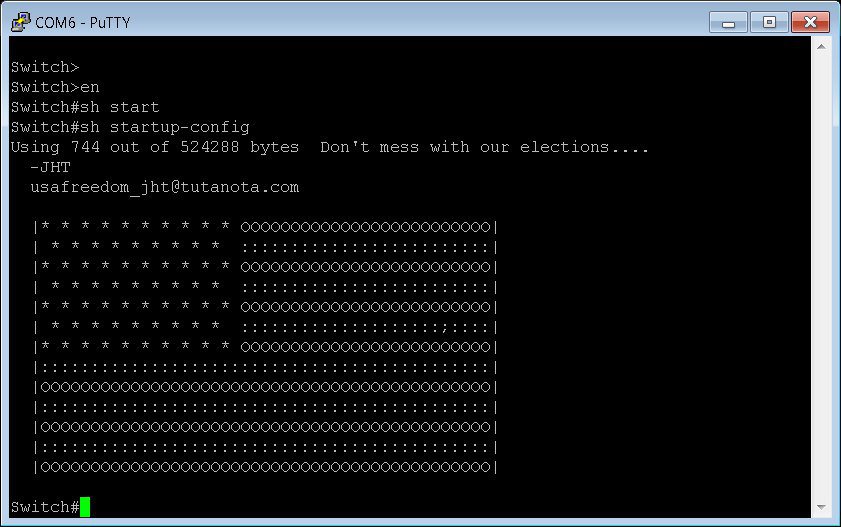
An anonymous reader quotes Motherboard: On Friday, a group of hackers targeted computer infrastructure in Russia and Iran, impacting internet service providers, data centres, and in turn some websites. "We were tired of attacks from government-backed hackers on the United States and other countries," someone in control of an email address left in the note told Motherboard Saturday... "We simply wanted to send a message...." In addition to disabling the equipment, the hackers left a note on affected machines, according to screenshots and photographs shared on social media: "Don't mess with our elections," along with an image of an American flag...
In a blog post Friday, cybersecurity firm Kaspersky said the attack was exploiting a vulnerability in a piece of software called Cisco Smart Install Client. Using computer search engine Shodan, Talos (which is part of Cisco) said in its own blog post on Thursday it found 168,000 systems potentially exposed by the software. Talos also wrote it observed hackers exploiting the vulnerability to target critical infrastructure, and that some of the attacks are believed to be from nation-state actors...
Reuters reported that Iran's IT Minister Mohammad Javad Azari-Jahromi said the attack mainly impacted Europe, India, and the U.S.... The hackers said they did scan many countries for the vulnerable systems, including the U.K., U.S., and Canada, but only "attacked" Russia and Iran, perhaps referring to the post of an American flag and their message. They claimed to have fixed the Cisco issue on exposed devices in the US and UK "to prevent further attacks... As a result of our efforts, there are almost no vulnerable devices left in many major countries," they claimed in an email.
Their image of the American flag was a black-and-white drawing done with ASCII art. -
Apple Tells the EPA Why Cutting the Clean Power Plan Is a Bad Move (theverge.com)
An anonymous reader quotes a report from The Verge: Apple is pushing back against the Environmental Protection Agency's proposal to repeal the Clean Power Plan. The company filed a public comment with the EPA today arguing that scrapping the policy, which calls for cutting power plant pollution, would dull the United States' competitive edge in the clean energy economy. The Clean Power Plan (or CPP) was finalized by the Obama administration, and it takes aim at power plants -- the number one carbon polluters in the U.S., according to the Obama-era EPA website. Had the CPP ever taken effect, it would have given power plants until the year 2030 to curb their carbon emissions by about 30 percent, a move that the Obama administration said could protect the environment, public health, and consumer's pocketbooks.
Apple's comment cites the economic advantages of supporting clean energy, including that it provides "corporate electricity buyers with a hedge against fuel price fluctuation." The price of solar and wind don't change like the price of oil, Apple's filing says. (It also notes that China is currently beating the U.S. in clean energy investments.) The company also says that regulating the grid's carbon emissions "power plant by power plant" won't work. It references its own experiences operating with 100 percent renewable energy here in the U.S. and the work of its subsidiary, Apple Energy LLC, which sells the excess electricity the company generates back to the grid. The electricity system is far too interconnected, the filing says, so "regulation should consider the dynamic and interconnected nature of how power is generated, sold and consumed." That's why it supports the clean power plan, which it says provides a nationwide framework for regulating electricity generation: "It is both needed and the smart thing to do." -
FBI Seizes Backpage.com, a Site Criticized For Sex-Related Ads (reuters.com)
The FBI has reportedly seized the sex marketplace website Backpage.com, according to a posting on its website on Friday. "The posting said the U.S. Justice Department would provide more information at 6 p.m. EDT," reports Reuters. "It said U.S. attorneys in Arizona and California, as well as the Justice Department's section on child exploitation and obscenity and the California and Texas attorneys general had supported the work in shutting down the website." From the report: Lawmakers and enforcement officials have been working to crack down on the site, the second largest classified ad service in the country after Craigslist that is used primarily to sell sex. The U.S. Senate passed legislation last month making it easier for state prosecutors and sex-trafficking victims to sue social media networks, advertisers and others that fail to keep sex trafficking and other exploitative materials off their platforms. The Supreme Court in January 2017 refused to consider reviving a lawsuit against backpage.com filed by three young women alleging the site facilitated their forced prostitution. But the site has since then faced a slew of other lawsuits alleging child sex trafficking. According to AZCentral, local FBI officials have confirmed "law enforcement activity" Friday morning at the Sedona-area home of Michael Lacey, a co-founder of Backpage.com. The raid comes amid what appears to be a shut-down of the website. -
Russia Files Lawsuit To Block Telegram Messaging App (reuters.com)
Russia's state communications watchdog, Roskomnadzor, has filed a lawsuit to block Telegram in the country because the instant messaging company has refused to hand over the encryption keys that would allow Russian authorities to read messages sent using the service. From a report: Ranked as the world's ninth most popular mobile messaging app, Telegram is widely used in countries across the former Soviet Union and Middle East. Active users of the app reached 200 million in March. As part of its services, Telegram allows users to communicate via encrypted messages which cannot be read by third parties, including government authorities. But Russia's FSB Federal Security service has said it needs access to some messages for its work, including guarding against terrorist attacks. Telegram has refused to comply with its demands, citing respect for user privacy. -
Facebook CEO Says Not Planning To Extend European Privacy Law Globally (reuters.com)
Facebook CEO Mark Zuckerberg said on Tuesday that the social network had no immediate plans to apply a strict new European Union law on data privacy in its entirety to the rest of the world. The news comes as Facebook reels from a scandal over its handling of personal information of millions of its users. Reuters reports: Zuckerberg told Reuters in a phone interview that Facebook already complies with many parts of the law ahead of its implementation in May. He said the company wanted to extend privacy guarantees worldwide in spirit, but would make exceptions, which he declined to describe. His comments signals that U.S. Facebook users, many of them still angry over the company's handling of personal information, may soon find themselves in a worse position than Europeans. The European law, called the General Data Protection Regulation (GDPR), is the biggest overhaul of online privacy since the birth of the internet, giving Europeans the right to know what data is stored on them and the right to have it deleted. Asked what parts of the EU law he would not extend worldwide, Zuckerberg said: "We're still nailing down details on this, but it should directionally be, in spirit, the whole thing." He did not elaborate. -
Russia Debuts Postal Drone, Which Immediately Crashes Into Wall (futurism.com)
On Monday, Russia's postal service tested a delivery drone in the city of Ulan-Ude, Siberia, -- and it went horribly wrong. According to Futurism, soon after launch it crashed violently into the wall of a nearby building, "turning the UAV into a mess of jumbled parts." From the report: Here was the original plan for Monday's test. The $20,000 drone was supposed to pick up a small package and deliver it to a nearby village, Reuters reports. Instead the device failed spectacularly, only making it a short distance before crashing into a three-story building. The small crowd gathered to watch the test can be heard uttering expletives, according to Reuters. No one was injured in the crash, and it didn't do any damage, except to Russia's pride. The organizers aren't quite sure what went wrong, but they suspect the 100 or so nearby wifi spots could have had something to do with it. -
Atlanta Still Struggles To Recover From Ransomware Attack (reuters.com)
An anonymous reader quotes Reuters: Atlanta's top officials holed up in their offices on Saturday as they worked to restore critical systems knocked out by a nine-day-old cyber attack that plunged the Southeastern U.S. metropolis into technological chaos and forced some city workers to revert to paper... Police and other public servants have spent the past week trying to piece together their digital work lives, recreating audit spreadsheets and conducting business on mobile phones in response to one of the most devastating "ransomware" virus attacks to hit an American city. Three city council staffers have been sharing a single clunky personal laptop brought in after cyber extortionists attacked Atlanta's computer network with a virus that scrambled data and still prevents access to critical systems. "It's extraordinarily frustrating," said Councilman Howard Shook, whose office lost 16 years of digital records...
City officials have declined to discuss the extent of damage beyond disclosed outages that have shut down some services at municipal offices, including courts and the water department. Nearly 6 million people live in the Atlanta metropolitan area... Atlanta police returned to taking written case notes and have lost access to some investigative databases, department spokesman Carlos Campos told Reuters... Meanwhile, some city employees complained they have been left in the dark, unsure when it is safe to turn on their computers. "We don't know anything," said one frustrated employee as she left for a lunch break on Friday.
"Our data management teams are working diligently to restore normal operations and functionalities to these systems," said a spokesperson for the police department, adding that they "hope to be back online in the very near future." -
Facebook Begins 'Fact-Checking' Photos, Videos (reuters.com)
Facebook said today that it had begun "fact-checking" photos and videos to reduce the hoaxes and false news stories that have plagued the world's largest social media network. Reuters reports: The fact-checking began on Wednesday in France with assistance from the news organization AFP and will soon expand to more countries and partners, Tessa Lyons, a product manager at Facebook, said in a briefing with reporters. Lyons did not say what criteria Facebook or AFP would use to evaluate photos and videos, or how much a photo could be edited or doctored before it is ruled fake. The project is part of "efforts to fight false news around elections," she said. Facebook has tried other ways to stem the spread of fake news. It has used third-party fact-checkers to identify them, and then given such stories less prominence in the Facebook News Feed when people share links to them. -
Uber Settles With Family of Woman Killed By Self-Driving Car, Avoids Lawsuit (arstechnica.com)
It appears that Uber won't go to court to settle a lawsuit after one of its self-driving cars killed a woman in Tempe, Arizona earlier this month. An anonymous Slashdot reader shares a report from Ars Technica: Uber has reached a settlement with the family of the woman killed by an Uber self-driving car. Uber reached the settlement with the daughter and husband of Elaine Herzberg, who died at age 49 after being hit by the Uber vehicle in Tempe, Arizona. The settlement presumably includes a cash payment, but no details were provided by either Uber or the family's attorney. "The matter has been resolved," said Christina Perez Hesano, an attorney for Herzberg's family, according to reports by Reuters and NPR. -
Facebook Tweaks Privacy Tools To Ease Discontent Over Data Leak (reuters.com)
Facebook has adjusted privacy settings to give users more control over their information in a few taps, it said on Wednesday, after an outcry over a whistleblower's allegations that members' data was used to sway the 2016 U.S. election. From a report: It put all the settings on one page and made it easier to change and more straightforward to stop apps using data. Until now changing settings had been complex, spread over at least 20 screens, which had frustrated users. The world's largest social network said in a blog post it had been working on the updates for some time but sped things up to appease users' anger over how the company uses their data and as lawmakers around the globe called for strong regulation. "Last week showed how much more work we need to do to enforce our policies and help people understand how Facebook works and the choices they have over their data," Facebook wrote in the blog post on Wednesday. -
Megaupload Founder Kim Dotcom Wins Battle in Ongoing Fight Against US Extradition (reuters.com)
Eccentric Megaupload founder Kim Dotcom has won a major court battle today in his ongoing fight against his extradition from New Zealand to the U.S. From a report: German-born Dotcom faces extradition to the United States relating to his Megaupload site, which was shut down in 2012 following an FBI-ordered raid on his Auckland mansion. U.S. authorities say Dotcom and three co-accused Megaupload executives cost film studios and record companies more than $500 million and generated more than $175 million by encouraging paying users to store and share copyrighted material. Dotcom, who has New Zealand residency, is fighting those charges and the extradition. The Human Rights Review Tribunal awarded Dotcom damages of NZ$30,000 ($21,816) for the "loss of a benefit" and NZ$60,000 for "loss of dignity and injury to feelings." -
Americans Less Likely To Trust Facebook than Rivals on Personal Data (reuters.com)
Opinion polls published on Sunday in the United States and Germany cast doubt over the level of trust people have in Facebook over privacy, as the firm ran advertisements in British and U.S. newspapers apologizing to users. From a report: Fewer than half of Americans trust Facebook to obey U.S. privacy laws, according to a Reuters/Ipsos poll released on Sunday, while a survey published by Bild am Sonntag, Germany's largest-selling Sunday paper, found 60 percent of Germans fear that Facebook and other social networks are having a negative impact on democracy [...] The Reuters/Ipsos online poll found that 41 percent of Americans trust Facebook to obey laws that protect their personal information, compared with 66 percent who said they trust Amazon.com, 62 percent who trust Alphabet's Google, 60 percent for Microsoft Corp.. -
Waymo CEO Expresses Confidence Its Cars Wouldn't Have Killed Elaine Herzberg (washingtonpost.com)
theodp writes: Nearly a week after an autonomous Uber SUV claimed the first life in testing of self-driving vehicles, The Washington Post reports that Waymo CEO John Krafcik says he is confident its cars would have performed differently under the circumstances (Warning: source may be paywalled; alternative source), since they are intensively programmed to avoid such calamities. "I can say with some confidence that in situations like that one with pedestrians -- in this case a pedestrian with a bicycle -- we have a lot of confidence that our technology would be robust and would be able to handle situations like that," Krafcik said Saturday when asked if a Waymo car would have reacted differently than the self-driving Uber.
In explaining its since-settled lawsuit against Uber last year, Google charged that Uber was "using key parts of Waymo's self-driving technology," and added it was "seeking an injunction to stop the misappropriation of our designs." In announcing the settlement of the lawsuit last month, Uber CEO Dara Khosrowshahi noted, "we are taking steps with Waymo to ensure our LIDAR and software represents just our good work." A Google spokesperson added, "We have reached an agreement with Uber that we believe will protect Waymo's intellectual property now and into the future. We are committed to working with Uber to make sure that each company develops its own technology. This includes an agreement to ensure that any Waymo confidential information is not being incorporated in Uber Advanced Technologies Group hardware and software." All of which might prompt some to ask: was Elaine Herzberg collateral damage in Google and Uber's IP war? "I want to be really respectful of Elaine [Herzberg], the woman who lost her life and her family," Krafcik continued. "I also want to recognize the fact that there are many different investigations going on now regarding what happened in Tempe on Sunday." His assessment, he said, was "based on our knowledge of what we've seen so far with the accident and our own knowledge of the robustness that we've designed into our systems." -
Dropbox IPOs. Its Founders Are Now Billionaires (cnbc.com)
Yesterday Dropbox finally launched its stock on NASDAQ. Reuters reports: Dropbox Inc's shares closed at $28.42, up more than 35 percent in their first day of trading on Friday, as investors rushed to buy into the biggest technology initial public offering in more than a year even as the wider sector languished... At the stock's opening price, Dropbox had a market valuation of $12.67 billion, well above the $10 billion valuation it had in its last private funding round... It has yet to turn a profit, which is common for startups that invest heavily in growth. As a public company Dropbox will be under pressure to quickly trim its losses. The 11-year old company reported revenue of $1.11 billion in 2017, up from $844.8 million a year earlier. Its net loss nearly halved from $210.2 million in 2016.
CNBC reports that Y Combinator almost passed on a chance to invest in Dropbox -- which became its first IPO ever -- "because it had misgivings about bringing on a solo entrepreneur." After Drew Houston, the creator of Dropbox, scrambled to find a co-founder in time for his in-person interview, the company was admitted into YC in 2007. Four years later, venture capitalists poured money into Dropbox at a $4 billion valuation. YC has since become a power player in Silicon Valley, helping spawn numerous companies valued at over $1 billion today including Stripe, Airbnb, Instacart and Coinbase. It also backed Twitch, which Amazon acquired in 2014 for about $970 million, and the self-driving tech start-up Cruise, which GM bought in 2016 for over $1 billion. But in its 13-year history, YC had yet to see any of its companies go public until Dropbox's stock market debut on Friday...
Houston is now worth over $3 billion and co-founder Arash Ferdowsi owns shares valued at more than $1 billion.
Dropbox's Twitter feed posted a video from their NASDAQ debut, adding "We're so thankful for the 500 million registered users who helped us get here." -
FCC Chief Cites Concerns on Spy Threats From Chinese Telecoms Firms (reuters.com)
Federal Communications Commission Chairman Ajit Pai, in a letter sent to lawmakers earlier this week (but released just now), said he shares the concerns of U.S. lawmakers about espionage threats from Chinese smartphone maker Huawei and plans to take "proactive steps" to ensure the integrity of the U.S. communications supply chain. From a report: Pai said he shares concerns over the "security threat that Huawei and other Chinese technology companies pose to our communications networks." Pai said he intends to take action in the "near future," but offered no specifics. Pai's letter follows the introduction of legislation by Republican Senators Tom Cotton and Marco Rubio in February that would block the U.S. government from buying or leasing telecoms equipment from Huawei, the world's third largest smartphone maker, or Chinese telecommunications equipment maker ZTE Corp, citing concerns the companies would use their access to spy on U.S. officials. -
China Regulator Bans TV Parodies Amid Content Crackdown (reuters.com)
China's media regulator is cracking down on video spoofs, the official Xinhua new agency reported, amid an intensified crackdown on any content that is deemed to be in violation of socialist core values under President Xi Jinping. From a report: The decision comes after Xi cemented his power at a recent meeting of parliament by having presidential term limits scrapped, and the ruling Communist Party tightened its grip on the media by handing control over film, news and publishing to its powerful publicity department. Xinhua said video sites must ban videos that "distort, mock or defame classical literary and art works," citing a directive from the State Administration of Press, Publication, Radio, Film and Television on Thursday. -
US Charges Iranians For Global Cyber Attacks on Behalf of Tehran (reuters.com)
The United States on Friday charged nine Iranians and an Iranian company with attempting to hack into hundreds of U.S. and international universities, dozens of companies and parts of the U.S. government on behalf of the Tehran government. From a report: The cyber attack pilfered more than 31 terabytes of academic data and intellectual property from 144 U.S. universities and 176 universities in 21 foreign countries, the U.S. Department of Justice said in a statement. The U.S. Treasury Department said on its website that it was placing sanctions on those accused and the Mabna Institute, a company described by U.S. prosecutors as designed to help Iranian research organizations steal information. -
BMW Says Electric Car Mass Production Not Viable Until 2020 (reuters.com)
BMW will not mass produce electric cars until 2020 because its current technology is not profitable enough to scale up for volume production, the chief executive said on Thursday. From a report: Munich-based BMW unveiled its first battery electric car in 2013, and has been working on different generations of battery, software and electric motor technology since then. The i8 Roadster model, due to hit showrooms in May, is equipped with what BMW calls its fourth-generation electric drive technology. Advances in battery raw materials and chemistry has increased its range by 40 percent over the previous version, BMW said. BMW is working to make electric car technology more modular and scalable to make mass production commercially viable. "We wanted to wait for the fifth generation to be much more cost competitive," Chief Executive Harald Krueger told analysts in Munich. "We do not want to scale up with the fourth generation." -
Kaspersky Lab Plans Swiss Data Center To Combat Spying Allegations, Report Says (reuters.com)
An anonymous reader shares a report: Moscow-based Kaspersky Lab plans to open a data center in Switzerland to address Western government concerns that Russia exploits its anti-virus software to spy on customers, according to internal documents seen by Reuters. Kaspersky is setting up the center in response to actions in the United States, Britain and Lithuania last year to stop using the company's products, according to the documents, which were confirmed by a person with direct knowledge of the matter. The action is the latest effort by Kaspersky, a global leader in anti-virus software, to parry accusations by the U.S. government and others that the company spies on customers at the behest of Russian intelligence. -
Google Makes Push To Turn Product Searches Into Cash (reuters.com)
Reuters reports of how Google is working to turn product searches into cash by partnering with some of the largest retailers in the United States: Under a new program, retailers can list their products on Google Search, as well as on the Google Express shopping service, and Google Assistant on mobile phones and voice devices. In exchange for Google listings and linking to retailer loyalty programs, the retailers pay Google a piece of each purchase, which is different from payments that retailers make to place ads on Google platforms. The listings will appear under sponsored shopping results and will not affect regular search results on Google, the company said. Google's pitch to retailers is a better chance to influence shoppers' purchasing decisions, a move that is likely to help them compete with rival Amazon. Google hopes the program helps retailers capture more purchases on desktop, cell phones and smart home devices with voice search -- the next frontier for e-commerce. The previously unreported initiative sprang from Google's observation that tens of millions of consumers were sending image searches of products, asking "Where can I buy this?" "Where can I find it?" "How can I buy it?" "How do I transact?" Daniel Alegre, Google's president for retail and shopping, told Reuters exclusively. -
Facebook Under Pressure as EU, US Urge Probes of Data Practices (reuters.com)
Facebook CEO Mark Zuckerberg faced calls on Monday from U.S. and European lawmakers to explain how a consultancy that worked on President Donald Trump's election campaign gained access to data on 50 million Facebook users. From a report: Facebook's shares fell more than 7 percent, wiping around $40 billion off its market value, set for their biggest drop since September 2012, as investors worried that new legislation could damage the company's lucrative advertising business. "The lid is being opened on the black box of Facebook's data practices, and the picture is not pretty," said Frank Pasquale, a University of Maryland law professor who has written about Silicon Valley's use of data. Lawmakers in the United States, Britain and Europe have called for investigations into media reports that political analytics firm Cambridge Analytica had harvested the private data on more than 50 million Facebook users to support Trump's 2016 presidential election campaign. Further reading: An undercover investigation by Channel 4 News reveals how Cambridge Analytica secretly campaigns in elections across the world. Bosses were filmed talking about using bribes, ex-spies, fake IDs and sex workers. -
China To Bar People With Bad 'Social Credit' From Planes, Trains (reuters.com)
China says it will begin applying its so-called social credit system to flights and trains and stop people who have committed misdeeds from taking such transport for up to a year. From a report: People who would be put on the restricted lists included those found to have committed acts like spreading false information about terrorism and causing trouble on flights, as well as those who used expired tickets or smoked on trains, according to two statements issued on the National Development and Reform Commission's website on Friday. Those found to have committed financial wrongdoings, such as employers who failed to pay social insurance or people who have failed to pay fines, would also face these restrictions, said the statements which were dated March 2. It added that the rules would come into effect on May 1. -
US Says Russia Hacked Energy Grid, Punishes 19 for Meddling (apnews.com)
Associated Press: Pushing back harder on Russia, the Trump administration accused Moscow on Thursday of a concerted hacking operation targeting the U.S. energy grid, aviation systems and other infrastructure, and also imposed sanctions on Russians for alleged interference in the 2016 election. It was the strongest action to date against Russia by the administration, which has long been accused of being too soft on the Kremlin, and the first punishments for election meddling since President Donald Trump took office. The sanctions list included the 13 Russians indicted last month by special counsel Robert Mueller, whose Russia investigation the president has repeatedly sought to discredit. U.S. national security officials said the FBI, Department of Homeland Security and intelligence agencies had determined that Russian intelligence and others were behind a broad range of cyberattacks beginning a year ago that have infiltrated the energy, nuclear, commercial, water, aviation and manufacturing sectors. Further reading: Russian Government Cyber Activity Targeting Energy and Other Critical Infrastructure Sectors (US-Cert); U.S. blames Russia for cyber attacks on energy grid, other sectors (Reuters); U.S. says Russian hackers targeted American energy grid (Politico); Trump administration finally announces Russia sanctions over election meddling (CNN); U.S. sanctions on Russia cite 2016 election interference -- but remain largely symbolic (USA Today); U.S. Sanctions Russians Charged by Mueller for Election Meddling (Bloomberg); and Trump Administration Sanctions Russians for Election Meddling and Cyberattacks (The New York Times). -
Largest US Radio Company iHeartMedia Files For Bankruptcy (reuters.com)
The largest U.S. radio station owner, iHeartMedia, has filed for Chapter 11 bankruptcy as it "struggles with $20 billion in debt and falling revenue at its 858 radio stations," reports Reuters. The company has reportedly reached an agreement with holders of more than $10 billion of its outstanding debt for a balance sheet restructuring, which will reduce its debt by more than $10 billion. From the report: Cash on hand and cash generated from ongoing operations will be sufficient to fund the business during the bankruptcy process, said iHeartMedia, which owns Z100 in New York and Real 103.5 KISS FM in Chicago. The filing comes after John Malone's Liberty Media Corp proposed on Feb. 26 a deal to buy a 40 percent stake in a restructured iHeartMedia for $1.16 billion, uniting the company with Liberty's Sirius XM Holdings Inc satellite radio service. Clear Channel Outdoor Holdings Inc, a subsidiary of iHeartMedia, and its units did not commence Chapter 11 proceedings. The company had 14,300 employees at the end of 2016, according to its most recent annual report.