 Slashdot Mirror
3D Display, No Glasses Required
Shibatch writes "Hitachi, Ltd has developed a 3D display called Transpost which can be viewed from
any direction without wearing special glasses. 3D movies can be seen as floating in
the display. Also, 3D movies captured at other places can be shown on the display
in realtime. The principle of the device is that 2D images of an object taken from
24 different directions are projected to a special rotating screen. They also
developed a camera which can capture images from 24 directions simultaneously." The pictures are interesting, but ... translations, anyone?
Help me Obi Wan Kenobi, you're my only hope.
It's just strobe interference with the cameras!
I remember this earlier Slashdot article discussing a similar technology. How long before these things are commodity hardware?
I can't read japanese as well as I once could but I think it says, "Here is our video-capture of the opening scenes from Star Wars Episode IV"
The caption on the second link says, "Help us, Obi-Wan."
That's about all I can make out.
http://www.worldlingo.com/products_services/worldl ingo_translator.html
Of course not perfect translation, but should able to give some draft idea what it is talking about.
http://hhil.hitachi.co.jp/products/transpost.htm
now thats great: i am finally going to be in EVERY single picture i take with that camera. hooo, my folks are gonna like those slideshows big time!
Square square square square square square square square square square square square square square square square.
And this is for the lameness filter... circle, triangle, dodecahedron, etc...
I'm a minister!
just imagine, tele-surgery becoming standard, video calls to loved ones being more and more special, blind people missing out on something else and won't sombody think of the pr0no industry???
---- Design. Invent. Cheese.
the artist Dali played with lasers and 3d holograms in the eighties, of note was a woman in a rocking chair that just floated in thin air (about 6in tall) (red)
Old news, but the best article I've read on this yet is the New Scientistarticle from a couple of years ago in which they first (for me) described realtime rendering using existing games. Interesting stuff.
Basically its just layers of projected images, spinning around to give the impression of volume. Still really neat though.
This isn't true 3D, it's stereoscopic. It uses a clever method to project stereo pairs, sort of like those rotating cylinder animated holograms they used to make (watch the end sequence of the film Logans Run if you've never seen one).
PC Watch article (Japanese) with many pictures
MPEG movie 1
MPEG movie 2
It seems to me like a system such as this would be rather inappropriate for watching movies. For one thing, making a device any much larger than a normal-sized tube TV would start to get really impractical, as the spinny elements would start to generate a lot of noise (and you WOULD NOT want to be there if a large, high-speed spinning element broke off of its axis and started ricocheting about the room...).
Also, unlike conventional holograms, you would not be able to "touch" the image. Reach out to touch these images, and the rotate-o-thingy will lop your hand off.
I shudder to think of the safety (and power consumption, and noise) issues that would be involved in making a movie-screen-sized version of one of these...
Something like this is probably more useful for scientific and military visualization. I know it's corny, but think of the Star Wars-like 3D display in South Park, in the scene where Bill Gates gets shot by the army guy. Something like that display machine...
Honey, I shrunk the Cygwin
What kind of geek doesn't wear glasses
Used Babelfish and then paraphrased it so it wasn't as engrish:
:/
But from what I can read, I can tell you this:
The stereoscopic video display that can been seen from all 360 degrees is in development. Video can be displayed on the fly. - Hitachi, Ltd.
This time, Hitachi has developed a new stereoscopic video display that allows viewers to view it from all 360 degrees. With this technology, viewers can see a 3D picture as if the viewer was using special glasses. It is possible to enjoy this stereoscopic image which just floats in the air without special processing. In addition, using a special video recording system, it is possible to display the images in real-time. Through the network, the photograph is sent (along with positional vector details), and the image is displayed. Various applications in the field are expected as the new technology matures.
Only bothered to do the first paragraph, as what babelfish produces is really really bad engrish
# It's called 'Transpost'
# It uses LCDs and mirrors
It'll be much better if a native speaker translates for us.
Founder of Mirror Moon - Tsukihime Game Trans
Please, please, please, for the love of all that's intelligible, can people refrain from posting babelfish "translations".
It's okay for the odd word or phrase, but for a whole article, it's just wrong. Or, as babelfish would put it:
Please, for those the love for all the those that is understandable, can satisfy please of refrain of babelfish of the writing of the "translations" of the peoples. It is for the odd word or the approval of the sentence, but for a complete article, he is necessarily false. Or, babelfish that it puts...
evil math within Nature's Cubic Creation!
So you dont need glasses to see it, but I can imagine after squinting at 24 rotating mirrors projecting a fuzzy blob into a vague space just in front of your nose you soon *will* need glasses!
Baz
This won't be big until its actually useful for something other than technical visualisation. But it's still cool...
Transpost product homepage (Japanese w/ pictures) at Hitachi Human Interaction Lab.
Other products from this laboratory include Waterscape (English).
require('includes/starwars.joke');
require('includes/pr0n.joke');
My work here is done.
... a machine that can look towards the future
I fuse with Mercer every single day...
I really wonder how these images you can see in the tube are created.
I could imagine it's a kind of fog where the image is projected by the help of lasers or other strong light sources.
I don't think this technique is very helpful because it requires really bulky "Displays", returning a relatively small picture.
If this does ever want to become generally accepted, the viewing appliances have to shrink and return bigger pictures, perhaps by sacrificing quality over price and bigger pictures.
-huha
Holy crap. My cat already goes bonkers with the mouse pointer in 2D mode. 3D?! She's gonna friggin explode!
..........
... SLAM!!! Kitty head goes face first into hard cold monitor, while simultaneously knocking over a half can of warm Dr. Pepper all over my keyboard.
I can see it now...
She crouches down, eyes fixed on the Mecca that is my cursor, while time and space come to a stand still...
Eyes fixed, heart beating swiftly, she tactfully wiggles her butt, to confirm her primal instinct. This... this is her moment... her destiny...
She twitches her noes and squints her eyes, and runs off feeling sheepish, as I make a half ass attempt to clean off my keyboard with a dirty laundry, cause im to lazy to find paper towels.
From the article description and pics, this seems to be a relatively simple concept, but nicely implemented. Although I can't read the article, I'm guessing that the "3d" effect is a much better version of those "holograms" that appear to move when you tilt at different angles (e.g. Ken Griffey player appears to swing when you tilt his baseball card). But instead of 2-3 images on a flat card, you have 24 images on a cylinder. Needless to say, it's not "real 3D" as none of 24 images themselves have depth.
Some people mentioned a strobing projector around a rotating screen as being the method used here. I wonder if also some sort of projector facing upward from below could be reflected laterally in 24 directions by a 24 sided mirror.
They then go on to explain a little more about the technology. They take video feed from 24 different angles and then feed that into their projection system which I think is a number of projectors inside a single machine. They then project it upwards onto some sort of rotating screen/plate.
They then talk some more about how it's automatic and works in realtime over a network.
Lastly they just talk about how a color projector like this is possible and what some of the uses might be (business, entertainment). Then at the bottom, they define the terms "holography" and "hitachi human iteraction lab".
Oops.
;p
Hey, at least I tried to un-engrish it
Founder of Mirror Moon - Tsukihime Game Trans
I am totally against this technology. Totally 100% vehemently abhorrent of it. If every 3d image requires 24 2d shots to create, this is going to make my porn image collection only one twenty-fourth of the size!
And now porn is going to take 24 times as long to deliver! For every 1 shot they want to get to the end user, the photographer has to do 24 times the work. Every second spent in the studio is a second that porn hasn't spent on my hard drive! BOYCOTT I SAY! BOYCOTT!
--
The last digit of pi is four.
Imagine Baywatch in 3D. I would have to take the day off when they had a marathon. I wouldn't be able to get off the couch. Although I'd ahve to sit a distance from the TV. Otherwise I would be dodging 3D "objects" the whole time.
Evolution or ID?
The porn industry seems to jump on new technology a lot faster than "mainstream" industries, proving the effectiveness of new tech so the big boys don't have to take any inwanted risks. Look at multi-angle DVD's, they are only just starting to show up in genres outside of porn, and how long has the technology been around?
Making the moon less necessary since 1998.
One of the firs applications of this new tech could be immersive karaokes, where you can sing your favourite song among a living 3D projection of the real band (without the singer of course)...
;)
Just imagine, the *huge* market that there is in Japan for this kind of stuff: all those japanesse business men impersontating Freddie Mercury after work
You may be moderating this as funny but that is the most serious/insightful comment you will see here.
If you think about it, it is going to be really hard to show scenery ie mountain landscapes on this screen - you can only show objects standing in a void - the demo piccies here show a man standing in the middle of nowhere. Think about Star Wars and Princess Leia standing in the middle of nowhere in R2's projection - there are no walls around her...
So if you think about it, the only real use for this are artificial landscapes like Air Traffic Control displays, and people.
Porn is _the_ killer app for this one.
I saw this (or something similar) on the 3D Festival in Copenhagen '99. No images captured from a camera, but realtime 3D. Very cool stuff, but I still don't see it on the consumer market.
/. at least twice (at least I think so, I don't read Japanese).
Similar displays have been featured on
http://www.computerworld.com/hardwaretopics/hardwa re/story/0,10801,69675,00.html
It's hard for thee to kick against the pricks.
.. if you've only got one eye, though.
If 3D ever become mainstream for computing environments, my big question is how we'll navigate it. You can't exactly move your mouse up and down through the table as it tends to leave big holes. Maybe an orientation-based thing a la Twiddler 1, or a POV button for vertical movement and rotation. It's something I haven't seen addressed at all, and if we want to get support for 3D computing then I think we need to start with some interesting ideas on how we'll use it.
Can you say that something is redundant, or only redundant to you? Do we impose our cultural standards on others when we mod?
If I post a goatse link and there's no one to read it, is it really trolling?
And if you are not myopic, you will think you are when you are looking at Casper the Friendly Ghost bustin' a move...
${YEAR+1} is going to be the year of Linux on the desktop!
As can be seen, a screen spinning rapidly about a vertical axis reflects images generated sequentially by a single projector, pointing up. The images first reflect off the mirrored top cover, down onto smaller mirrors arranged around the base of the viewing chamber onto the spinning screen. The full 3-D cycle of images are projected once per revolution of the screen, so the screen sees a slightly different image as it aligns with each mirror.
The screen is near-transparent, so it is possible to look "through" a projected image. Suggested uses include an information display terminal, a video conferencing terminal or an arcade game.
Of course, 24 video cameras at the transmitting side won't be cheap.
All the cameras involved would need to synchronize their frames ala time-based correctors we used to use for video editing, else you'd probably get some disconcerting flicker as you moved around it...
"Waste not one watt!" - CZ
Many people are dubious about 3D screens. This is understandable as there have been doezens of them and none has "made the grade"
The reason for this is simple: stereopsis is, while whiz-bang, is not "interesting". After the initial gee-whiz the grim reality of the lack of value added benefits for the cost always come into play.
Today the tag "3D" has a fuzzy meaning, but it is usually interpreted to mean mere stereopsis: artificial illusion created by presenting each eye a differing perspective of am in image.
The reason stereopsis fails is that it only provides a fractional increase in information, where as "holographic" (a misnomer) provides a full dimensions worth of information.
To explain it simplest: stereoptic images have one depth of focus, whereas a "holographic" image has thousands of "planes" of focus. A holographic image allows you to focus your eyes at different depths whereas a mere stereoscopic image keeps your eyes focused at one depth.
When it comes down to it, its about information density; fake stereroptic effects add no information. So we can conclude that "3D" technology won't ever become mainstream until true depth "holographic" imaging is available.
Bottom line: this screen is not worth its cost. Give us depth of field.
way we can manage to project a true 3d hologram like in starwars would be once we conquer light - when we can restrict the distance it travels - without it losing its brightness...
Guess as of now its impossible to project a holo from a single point/side source using current technology
This idea however is brilliant.. i guess.. 24 cameras would mean.. 24 fps.. where each frame would be a pic from a successive camera, and the screen rotates to those 24 positions each second...
Now that someone has implemented it, it sounds so simple
|/________
|\A|ALYS|
the next thing you know playboy.com will be /. for announcing a joint buying of Hitachi, with hustler.
-- Ben --
Years ago, when I was in my Street Fighter II Turbo days, I used to go to an arcade in Fox Valley, IL. They had an arcade game there that had a flat screen and the characters would stand up out of it, much like the pictures show attached to this story. So this technology has been around for years, and I always wondered when it was going to pop up again for mainstream use.
The real question is: does anyone know what the name of that arcade game was? I'd love to be able to prove what I'm saying by providing a googled link...but I can't remember. It was something to do with space travel, I can tell you that much...and it played more like a choose your own adventure than an action game.
sev
but have you considered the following argument: shut up.
Either your images have to be very simple, or you need extremely powerful hardware, or the resolution sucks, or you're going to have to accept low frame rates.
I wonder how frame rate relates to the rotational speed of the projection surface.
Slashdot quality declines as the number of hot grits posts decreases. - Provolt's Law, Apr-09-2005
Someone gets a story on slashdot in another language with pictures you can barely see...an I can't get any story on here ever! HA!
what?
This isn't anything new.
nVidia has a laptop @ COMDEX that displayed in 3D with no glasses needed.
Thanks for providing this, but why not put the the clauses into English ordering, instead of this word-for-word transliteration from the Japanese?
http://www.lemminginvestor.com/DDDpresentation.htm l
Damn! How can we objectively compare different 3D technologies by looking at 2D pictures on a screen? We need 3D monitors in order to see which one "looks" best, surely?
biopowered.co.uk - catalytically cracking triglycerides for home automotive use since 2008. Just say no to big oil!
One footnote - I found that people who can't see 3d in real life and can see with both eyes could see 3d with my pictures. Blew them away.
The point I'm making is that 3D comes out and then it seems that it is a very tough sell. People just won't switch.
I would speculate that the best application of this new 360 degree technology would be the porn industry. They could get very good "penetration" in that market (-: Ok... I won't quit my day job.
Look closely, the image is not "freestanding," you always see the image in front of an imaging plate in the background. It appears to be freestanding because it appears in the center of the chamber, but there's always a screen behind it.
This'll bring back one of the weirder architectural designs from the 70's..the conversation pit...
Instead of sitting in front of the TV...people will sit around it...
Probably wouldn't work for sports though...at least not until they have a few crays laying around processing the every second of play to track an morph the images from 24 cameras all having to run at different levels of zoom...
Nice for soaps and sitcoms...Boxing matches...But football would be a little tougher...
"Helping to keep you two steps ahead of the Thought Police!"
For those wondering how this system works here is the actual article:
Viewers gaze at a live three-dimensional image produced with groundbreaking technology unveiled by electronics giant Hitachi Ltd. on Tuesday. Hitachi's device is the first in the world that can record and instantly display three-dimensional images from 360 degrees.
Up until now two steps were required: special filming using lasers and the intermediate process of physically recording the image, meaning that the image could not be seen at the same time as filming.
The circular viewing device stands about 2 meters high and is 40 centimeters in diameter. The image of the person being filmed is portrayed onto a high-speed spinning screen from angled mirrors.
When viewed from the side, the person's face can be seen and their back is visible when viewing the object from the opposite direction.
The person or object being filmed is surrounded by 24 mirrors and recorded with a camera. This recorded image is instantly transmitted to a projector in the viewing device. (Mainichi Shimbun, Japan, Feb. 24, 2004)
To see the picture, which is larger than the ones on the Hitachi site, go to Mainichi Daily News and in the lower right corner of the current picturce click 'More'. When the pop-up occurs click 'Next' to see the single picture and the text I just posted.
I hope this helps.
Hitachi Co. Ltd. (CEO: Etsuhiko Shouyama) has developed a novel 3D image display technology, which allows a 360 degrees view from any direction. The technology allows a viewer to enjoy a 3D image that appears to be floating in the middle of the air. With the proprietary camera system, one can take and view a captured real-time 3D image. The taken image can be sent over a network and played in distant places simultaneously --- this makes a totally new presentation style possible. The technology is expected to be use as a new image-based information system in various fields.
Holography has been a well-known method for playing floating 3D images to date. However, playing a 3D image requires preparation of an interference pattern (hologram), and this make real-time playing of a captured 3D image impossible.
Real-time playing of a captured 3D image will bring, for example, projection of 3D images of a person or an object in the air, which has appeared in SF movies, to the real world. As a new style in oversea business, discussion of a product design or a presentation to a customer can be made based on the image of a sample freshly made here in Japan.
The Hitachi Human Interaction Laboratory in the Hitachi Fundamental Research Center has developed the 3D image display technology that allows one to view a real-time 3D image floating in the air from any direction. This comes with a demonstration system, cylindrical 3D image display "Transport." The developed display technology has the following features.
(1) 3D image display by a simple mechanism
The system is based on simultaneous projection of the images of a subject taken from multiple direction onto a proprietary prepared rotating screen. In the experimental display "Transport," the images of the subject taken from 24 different directions are projected to (a) mirror(s) at the top by (a) LCD projector(s) set in the base. The projected images are reflected by the mirror(s) to 24 mirrors placed around the rotating screen, and further directed on to the screen.
(2) Real-time display of captured 3D image
The Lab developed a proprietary camera system that automatically produces images of a subject from 24 different angles. Directly sending the images captured by the camera system to the LCD projector displays the captured 3D image in real time. The captured image can be sent to a distant place by connecting the camera system to "Transport."
The developed 3D image display technology can handle both still and animated images with full colors and from computer-generated graphics to real image captures. The technology may find various applications in business and entertainment as a unconventional display system for 3D image presentation and information distribution in the ubiquitous era.
(Notes about *1) holography and *2) Hitachi Human Interaction Lab)
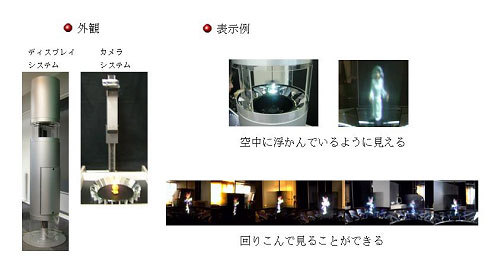
Left: Overviews of the display system (left) and the camera system(right)
Right: (top) "It appears to be floating in the air."
(bottom) "One can move around and see."
Sharp has had a 3D laptop using technology that looks almost identical for quite some time now. Take a look at
k s/ actius/rd/3d/#
http://www.sharpsystems.com/products/pc_noteboo
The best part of the unit was the big button on the top of the keyboard. You hit it and it lights up green and says "3D". Oh so gaudy.
The display takes anywhere from one to 10 images to get used to, but it does work well. The lack of anti-glare coating can make usage in some orientations troublesome, but that can be overcome by moving the machine/user.
I thought I had see something like this before from Canterbury University. A few people have tried solutions like similar to this. Check out http://www2.eng.cam.ac.uk/~arlt1/research/third/al l3d.html.
This Hitachi display is not new technology and it has some problems, principally:
On the upside:
It would be most useful for applications such as air traffic control, etc.
It competes with the other autostereoscopic displays (the LCD shutter glasses will never break out of their nerd/medical/scientific-imaging market for social and multi-tasking reasons), of which there are only really 2 consumer-market viable architectures:
The other displays linked to in the comments, and various others not linked, are all variations on the parallax barrier approach. Again, not new. They have the benefits of:
They have the big downsides of:
The limited viewing angle practically requires most parallax barrier systems to use active head tracking systems, where the display identifies where your eyes are and retargets the imaging accordingly. This exposes the practical usefulness of the 3D image to a further potential degradation if the headtracking system is not spot on.
Sharp and Dresden both use parallax barrier. Dresden's is beautifully bright but its headtracking can unfortunately jump the image around very badly for some people -- speaking from experience, it is beyond unusable if you're one of the unlucky ones, the image is jumping inches in random directions on random sub-second intervals.
Another major disadvantage is the extreme difficulty of presenting a 2D image via parallax barrier systems, thereby sharply restricting its desktop market. If you want to write or read something, such as a spreadsheet or some code or a word document, you're out of luck -- you need another monitor.
The other approach has been developed by a single company comprising now 2 people (holographic artists) about 10-12 years ago. The Display:
If I remember correctly, it was encased in a dome so you could only see it from the front (160 degrees or so) or from the top. It wasn't 360 degrees viewable, but probably didn't need to be.
...just my 2 gil.
Thank you, that was a very informative overview. I always wondered why we don't have holographic TV already! :)
This sonic transducer - it is, I suppose, some kind of Audio-vibratory, physiomolecular transport device
Who wants to go to the movies and realize the only seats left are the ones where you'll be looking at the back of everything?
It makes more sense to record only 90 or 180 degrees and then project 2 or 4 relativley forward views around a central projection system. Although, in a theater scale you'd need a lot more than 0.067 (24/360) images per degree for a stereoscopic effect to be visible.
No, this kind of tech doesn't makes sense for movies. Perhaps it would be effective for visualization of computer-modeled objects where the user can move around the display to look at the various sides of the object. It would be great as a aux. display on a CAD/CAM system!
Here's your Japanese -> English -> German -> French -> English translation.
With regard to of KorporationHitachi, Ltd.. on 24, the new advertisement of exemplary sight technology stereoskopische, to everywhere consider can was announced with the image of 360 degrees.
The institute "Hitachi the human interaction laboratory of same company (HHIL)" the opening which is something which is sent, the system of its layout of the sight stereoskopischen in the real time contrary to the system of sight stereoskopische is possible, old Holography used, independently picture/calmement the illustration animated. The image which is formed, the side and the back of the topic can as image of measurement 3 to see projects its luminous eye of stereoskopischer seen is possible.
, to project the image that the plural of the directions, with the special screen of the rotary type, the system of sight stereoskopische which it tests, when stereoskopischer seen one sees photographed. Anblickdisplay-Links stereoskopische "Transpost" which is released, with the framework of the cylindrical state approximately the height 2m, establishing in the projektor with the lower part. To surround the special screen of the rotary type that on the medium of the cylinder was, also arranged 24 mirrors, cover the part become the Hari mirror.
Check out this other interesting or should I say bizarre stuff.
http://hhil.hitachi.co.jp/products.html
"You get all the fun of sitting still, being quiet, writing down numbers, paying attention...science has it all."
Serious question.
I have a set of eye conditions (farsightedness combined with astigmantism) that means my right eye is nearly totally dominant (that is, i "look" out of it primarily) And as a result, conventional (with glasses) 3d things dont work worth a damn for me, because i only see the blue side.
It doesn't SEEM as if my eye dominance problem would make a difference, as with this setup you're not having to view and interpolate two streams of data, but I could be wrong.
Opinions anyone more qualified tahn me?
If you can't see the value in jet powered ants you should turn in your nerd card. - Dunbal (464142)
"Obi ran, all my hope are belong to you. EKEKEKEKEKEKEK"
There's a few (very short) enlish news blurbs:
Ananova
Akiba live, which ananova mentions and links to.
In A.D. 2101
...."
War was beginning
Captain: "What happen ?"
Mechanic: "Somebody set up us the bomb."
Operator: "We get signal."
Captain: "What !"
Operator: "Main screen turn on."
Captain: "It's you !!"
CATS: "How are you gentlemen !!"
CATS: "All your base are belong to us."
CATS: "You are on the way to destruction."
Captain: "What you say !!"
CATS: "You have no chance to survive make your time."
CATS: "Ha ha ha ha
You would think Hitachi could hire a photographer with just a tad of marketing skill.
I thought of something like this years ago. If I can come up with it, I'm pretty sure a bunch of other people have.
Im interested in what kind of display they used.
It's not easy having a good time. Even smiling makes my face ache. And my children turn on me - Rocky's behaving just the way that Eddie did. Do you think I made a mistake - Splitting his brain between the 2 of them?
"And now, Frank N. Furter, your time has come. Say 'goodbye' to all of this, and 'hello'... to oblivion!"
It's kind of cute how they set it up at just there right height for a japanese person to read - 172.6cm.
The infinite limit of this approach is a hologram.
I don't think so. Holograms let you produce 3D images of solid, completely opaque objects.
With this "spinning screen" approach to 3D, I don't think it's possible to produce object images that aren't somewhat translucent, no matter how many 2D images you put together to make the 3D display. You can make light radiate from all the appropriate places on the 3D image, but there doesn't seem to be any way to make sure that light is allowed to reach the viewer in some directions but occluded in others.
As far as I know, there is much better device, more TV-look-a-like, and it was presented on RSNA 2003 in Chicago, last december. Although dr. Harkany gave me this info, I did not have seen actual device, but this 3D display was invented in Hungary, and since it really looks like TV, it gives 180 degrees, but nice-looking 3D view. Do some googling...
Doing a good job is like spilling coffee on a dark suit, you feel warm all over, but nobody notices.
Granted this project outgrew its modest high-school roots, but judging from the pictures the technology seems to be very similar.
Hey do us all a favor and post this cool artical when its in English.
The caption over the far left picture says "display system", the one to its right says "camera system", the one below the bottom right picture says "(the hologram) can be seen from anywhere". I'm not sure what the caption for the top-right picture says (don't have my kanji book with me).
i see some people have provided translations of the text already. guess i might as well do the picture captions (although you can probably figure them out by context), since you can't use a translator for those.
on the left, the bullet says: "outward appearance"
the left picture is the "display system" and the right one the "camera system".
on the right, the bullet says: "display samples"
the top caption says: "it appears to be floating in mid-air."
the bottom caption says: "it is possible to walk around and view it."
something like that. hope that helps.
-geikou
Good thing I read the warning label that said: "Don't look directly at beam with remaining good eye"!!!
the preceding comment is my own and in no way reflects the opinion of the Joint Chiefs of Staff
Back at Cambridge University in England twelve years ago I saw a demonstration of a 3-D screen which did similar things.
Basically what they had was a high speed CRT, and in front of it they put an LCD-based filter and a lens system. The CRT showed consecutive images for multiple viewing angles, and the LCD filter worked in conjunction to ensure that only the correct images would be seen at the correct viewing angles. I can't remember the full details now (it was 12 years ago!) but the display did really seem to have depth and the images really did seem to jump out of it. They tried to ensure that when viewing the screen at a reasonable distance you would get different images for each eye. No glasses required.
The refresh rate wasn't astonishing, and the screen was only monochrome, but it was very effective. They were talking about making a colour version based on LCDs, but the big problem with using LCD screens back then was the switching time for the pixels.
I was seriously impressed by the demo I saw and have been waiting ever since for this to become a real product. I'm not holding my breath though - the amount of data required for 3D TV (or 3D movies) for these kind of screens is immense. Whilst modern digital satellite TV can carry hundreds of channels from a single satellite the same satellite would only be able to carry a handful of 3D broadcasts (if you want to ensure a decent 3D picture). I think you'd probably need something faster than Internet 2 for cable-based transmission.
One day though....
I sware.. every futuristic item in that film is gonna be possible.. even the changing newspaper.
That was, as another poster said, quite informative. Thank you.
What doesn't make sense to me though is your use of "holographic". From what I know, the cool thing about holography is that every angle is captured for every point in space. Reproducing this amount of information from just two offset photos (or game-generated images) is impossible. It may *look* like a hologram from a particular point of view, but it cannot actually *be* a true hologram without all that extra information.
In the case of a game, the computer would have to know the location of your eyes (and thus your viewing angle) to generate the appropriate two stereoscopic views - without this knowledge, it certainly can't render the infinity of views required for multi-angle viewing (not without a *huge* increase in computing power).
Feel free to correct me if I'm wrong - it may be that my understanding of holography is flawed.
About a year ago the Actuality people did a demonstration for a group that I worked for with a functional prototype.
Basically, their display consisted of a number of projectors projecting a 3 dimensional image onto a rotating plexiglass screen.
The upside:
The were indeed 3D, which allowed you to have a much better sense of their shape and structure.
The downside:
The display was rather loud because of the rapidly spinning plexiglass plate. The Actuality guys said they were working on a solution.
The plexiglass was spinning so quickly, I had the feeling that it was going to fly apart and kill everyone in the room. This is not to say that their display is flimsey, but that they should use high strength materials to prevent this from happening...maybe they already do.
The 3-D objects themselves were small. This is probably limited by the projection technology that they are using. I'd imagine that if they switched to projecting images with scanning lasers, then they would be able to project a distortion free image over a bigger portion of the screen.
You still felt separated from the objects projected because of the glass barrier. This is not something that they could correct, but better interface devices would help.
The displayed images were translucent and lacked contrast. They were working on fixing this. I don't think it's a fixable problem if they used the right combination of projector and screen material.
The displayed images were kinda fuzzy. This might have to do with the thickness of the rotating plexiglass part, so I'm not sure how they could correct this.
The price. OUCH. Not only do you have to buy the display, but you also have to license the software at tens of thousands of dollars per year. That's the kind of money that only a dot com would be willing to shell out for the product that they had, and there aren't many of those around now.
Summary
Interesting technology, but shortfalls and exorbitant price means it's not quite ready for market.
Makes me wonder if Hitachi is infringing on Actuality's IP.
I guess those guys must be Jesse Eichenlaub and Arnie Lagergren from DTI. Their displays have been discussed before.
i'm sure they've got a patent somewhere for this.. heh
I believe sex is highly over rated... unless it involves me
I remember hearing about something like this being developed at the Uni. of Otago here in NZ in the late '90s.... a rotating screen, on to which was projected a little running stick figure from multiple angles. Upshot was you could view it from any angle, perspectively corrent....
Wonder if this is based on that (seems like the same idea)?
This pretty much proves the point that the Japanese can only innovate existing ideas and are no good at coming up with original technology. Remember many months back the guy who invented an actual floating display? It didn't project onto anything; the images just floated in mid-air (he explained the principle as exciting air mmolecules to make an image).
Japanese solution: a rotating screen. 2D pictures taken from 24 different positions. PLEASE! That is so amateurish. I think someone could have done this with 1902 tehcnology.
Or the gaming industry. Imagine playing a FPS with depth perception.
Games have always pushed the boundries of technology. I'm supprised VR isn't widely used in games yet.
I'd pay $300 for glasses for my PS2 if I had games that would work with them too. (just add another camera angle, how hard is that?)
"That's so plausible, I can't believe it!" - Leela
"works for people with only one eye"
Is this so? I have two eyes, but I have very poor sight in my left, so I have lost my 3D and depth perception. It will be extremely interesting to be able to see 3D (for the first time ever!)
Must have been very late 70's or early 80's issue. Article had details about two homebuilt systems, one with a mylar film over a loudspeaker and the other used a rotating angled mirror. Projection was via an oscilloscope. I seem to remember the photos of the setup showed a wireframe cube.
Like these guys' website...
Reason is the Path to God - Anon
I just got one of these. When Wesley walked out of the holodeck, some of the fake snow on his shoulders fell right out of the monitor and melted on my floor!
to layer a varying number of screens of differing widths and displaying certain depths on each plane to somewhat simulate a 3d display? I guess a better way to describe what I'm thinking is to think of "stacking" moving gifs with transparent backgrounds in in three dimensions.
Making movies so that everything that needs to be visible is visible would be harder.
And making movies where something should not be visible or should be hidden, will be harder.
If this catches on it might spawn movie story telling techniques where the story seems different depending on where the viewer is sitting.
veliath
Watching TechTV today and on thier news program, TechLive, they talked about a new laptop computer that was released by Sharp called the Actius RD3D. Sharp is calling the laptop the first "auto-stereo" laptop. I don't have much by way of tech specs but check out the article and sharp's web page for the details. sounds interesting but not practicle.
Too many secrets; Hack the planet
It was based on quickly switching between two images of the same scene taken from slightly different angles.
The problem with it was that it was not possible to get rid of the flickering without getting rid of the 3-D effect as well.
Those who sacrifice security to condemn liberty deserve to repeat history or something. - Benjamin Santayana
No, DTI's display is a parallax barrier design.
:)
Note the physical layout in http://www.dti3d.com/technology.asp/
Also, you'll note their website and business approach is quite professional
--
Sal
Writings: saltation.blogspot.com
Wravings: go-blog-go.blogspot.com
I have the same eye pattern when I'm not wearing glasses/contacts.
I'd be very surprised if you've lost depth perception. In fact, for high-speed or close-tolerance activities, a single eye is superior to two for purposes of precisely judging location. This is because it's less "noisy" for the brain to identify what's happening to the objects' locations. For example, if you're doing any high-speed thread-the-needle manoevres in a car, close one eye to improve your understanding of the physical layout that's about to become so very important.
The brain normally uses BOTH dynamic parallax (what happens to the image when the eye/head moves?) and static parallax (what happens to the image when looked at from the left eye vs the right eye, and also, what angle are the eyes physically pointing at?)
With a single eye, the brain can create 3D images by comparing how the image changes as the eye (head) moves. The parallax between the two images allows a precise fix on the shape and location of the object observed. Most spiders use parallax to build up a 3D view of the world, for example, in case you've ever wondered why they bounce/vibrate in the final inches as they creep up on their prey.
Using only one eye DOES mean you can't create a static 3D image, you must move. This means you won't be able to take advantage of autostereoscopic displays, Im afraid, as they serve up predigested images catering to the expected angles to the eyes (the "frustum" IIRC).
To use a 3D display, you can either use one of the volumetric displays such as the Hitachi one, or use glasses/contact lenses to level the power of both eyes.
cheers
Sal
--
Sal
Writings: saltation.blogspot.com
Wravings: go-blog-go.blogspot.com
Alas, 3D TV, although the holy grail, is a whole 'nother kettle of fish. You want to have all your family/friends parked in the living room watching the 3D, so you need to have multi-viewer capability. Multi-viewer 3D is very easy for the software to deliver but rather more difficult for the hardware to deliver.
Unless you force viewers to sit themselves in particular "sweet spots", the display must have head-tracking capabilities, must be constantly scanning the room to identify where people are, and then building and presenting images for/to their locations.
You are therefore completely at the mercy of the headtracking system, assuming your display design is even capable of throwing multiple images, which many aren't. And these systems do have problems with unusually shaped people, eg dark rings under eyes, sunglasses, etc.
I believe there ARE usa tv channels broadcasting in 3D. Presumably this is for the mad-keen out there with their LCD shutter glasses, or those who watch tv alone.
Sal
--
Sal
Writings: saltation.blogspot.com
Wravings: go-blog-go.blogspot.com
I can't believe there is someone moderating on slashdot that doesn't know the star wars script. Incredible!
Cool! I'm not crazy...
Is the refresh rate any higher with HDTV? I wonder if alternating the frames might be possible then?
"Anyone that has ever gotten an idea based on any of my work and done something better with it-good for you."--J.Carmack
I think that the effect relies on the perception of alternating frames.
If you switch the frames so fast that the flickering disappears, the 3-D effect goes away, and looks like a double-exposure instead.
(At least, that is what I think happens.)
Those who sacrifice security to condemn liberty deserve to repeat history or something. - Benjamin Santayana